

The 3am wake-up is its own kind of tired. You go to bed fine, you sleep for a few hours, and then you are awake and hot and throwing a leg out from under the covers while your husband sleeps under a comforter like it is January. Dale does that. I have watched him pull the comforter up to his chin while I am lying there calculating whether it is worth getting up to drink water and stand in front of the fan.
I bought a tower fan about three years ago, when the night sweats started getting serious. The first month I had it, I used it wrong. I put it in the corner where it looked tidy, pointed it at the ceiling, and ran it on the highest speed because high felt like it was doing more. Then a friend who sleeps hot year-round told me to move it, aim it, and stop fighting it, and my nights changed. Here is what I learned, applied to the DREO tower fan I use now, and it holds for most tower fans you would buy for a bedroom.
The fan I stopped moving around at 3am
DREO's bedroom tower fan runs at 28dB on its quiet setting, stands 36.26 inches tall, and comes with a remote so you do not have to get out of bed to change the speed.
Amazon Check Today's Price on Amazon →Start With Placement, Because Everything Else Depends On It
Most people put a tower fan against a wall, in a corner, or wherever the cord reaches without a fight. That is where a fan is least useful to a sleeper. A tower fan moves a column of air forward, not sideways, so its position relative to your body matters more than its speed setting. If it is behind your head, you get noise and very little cooling.
The fan should sit two to four feet from the bed, roughly level with your shoulders when you are lying down, and it should be angled across the bed rather than straight at your face. Angled airflow sweeps over your skin instead of blasting one spot, and that moving air over bare skin is the whole mechanism. It helps evaporate moisture and it makes the air feel cooler than the thermostat says. I keep ours on the floor near my nightstand and aim it up and across toward my pillow, so it washes over my side of the bed and never touches Dale's.
Step 1: Pick the Right Corner of the Room
Before you plug anything in, walk to the spot where you would put the fan and lie down on your side of the bed. Look at it from pillow height. If the fan would be behind your head, hidden by a nightstand, or pointed at a wall six inches away, move it. A tower fan that pushes air into furniture is just an expensive white noise machine.
The best spot is usually on the floor beside the nightstand on your side, angled so the airflow crosses your upper body. If you have a west-facing bedroom like ours, which soaks up afternoon heat through the wall, keep the fan a little away from that wall. The wall itself stays warm into the evening and standing right against it does the fan no favors. Six to twelve inches of clearance also keeps the intake from pulling in dust and curtain fabric.
One more thing: check the cord. A cord running across the floor between the bed and the bathroom door is a trip hazard at 3am, and it is exactly the kind of thing you only notice once. Route it along the baseboard, and use the fan's oscillation to cover the angles you cannot reach with a fixed aim.
Step 2: Height and Aim Matter More Than Speed
This fan is 36.26 inches tall and weighs 8.4 pounds, which puts the top of the airflow column roughly at shoulder height for a person sitting up in a queen bed. That is a useful height, but you can do better by thinking about where the air actually needs to land. For a hot sleeper, the target zone is the chest, neck, and shoulders, because those are the areas that feel the heat first and the areas that dry off fastest with moving air.
Aim the fan slightly upward and across. Not straight down at the mattress, which just stirs the warm air pooled around the bed, and not straight up, which cools the ceiling. I set ours to a gentle upward angle and let it wash over my upper body. If you share a bed with someone who runs cold, angle it so the airstream dies before it reaches their side. A fan aimed down the middle of a shared bed is the fastest way to start a small domestic dispute about temperature.
Use the 90 degree oscillation if you want the air to sweep rather than sit. Some people love oscillation for sleep and some find the changing air pressure wakes them up. Try one night each way. There is no universal answer, and it takes ten seconds to switch.
Step 3: Set the Speed for Sleep, Not for Relief
Here is the mistake I made for a month. I would wake up drenched, get up, and crank the fan to its highest speed to feel better immediately. Then I would lie back down in a gale and be too cold and too noisy to fall asleep, and I would wake up later with a stiff neck. Relief and sleep are two different settings.
This fan has four speeds, and the level you want at bedtime is usually one or two, not four. At 28dB on the quieter settings it is about the level of a quiet room with a little air movement, which is the range I can sleep through. My pattern is to start on speed two when I get into bed, while my body is still warm from the evening, and drop to speed one when I wake up at 3am. If I wake up hot and clammy, I go up one notch and let it run for twenty minutes, then drop back down.
Try that ladder instead of a single fixed speed. It matches what your body is actually doing overnight, which is cooling down through the first half and then fluctuating.
Step 4: Learn the Timer and the Remote So You Stop Getting Out of Bed
The getting up is what wrecks the night. You are awake, you are hot, you get up to fiddle with a fan, you are now fully awake and thinking about your sister's birthday and the dentist appointment. Every one of those trips to the fan costs you sleep.
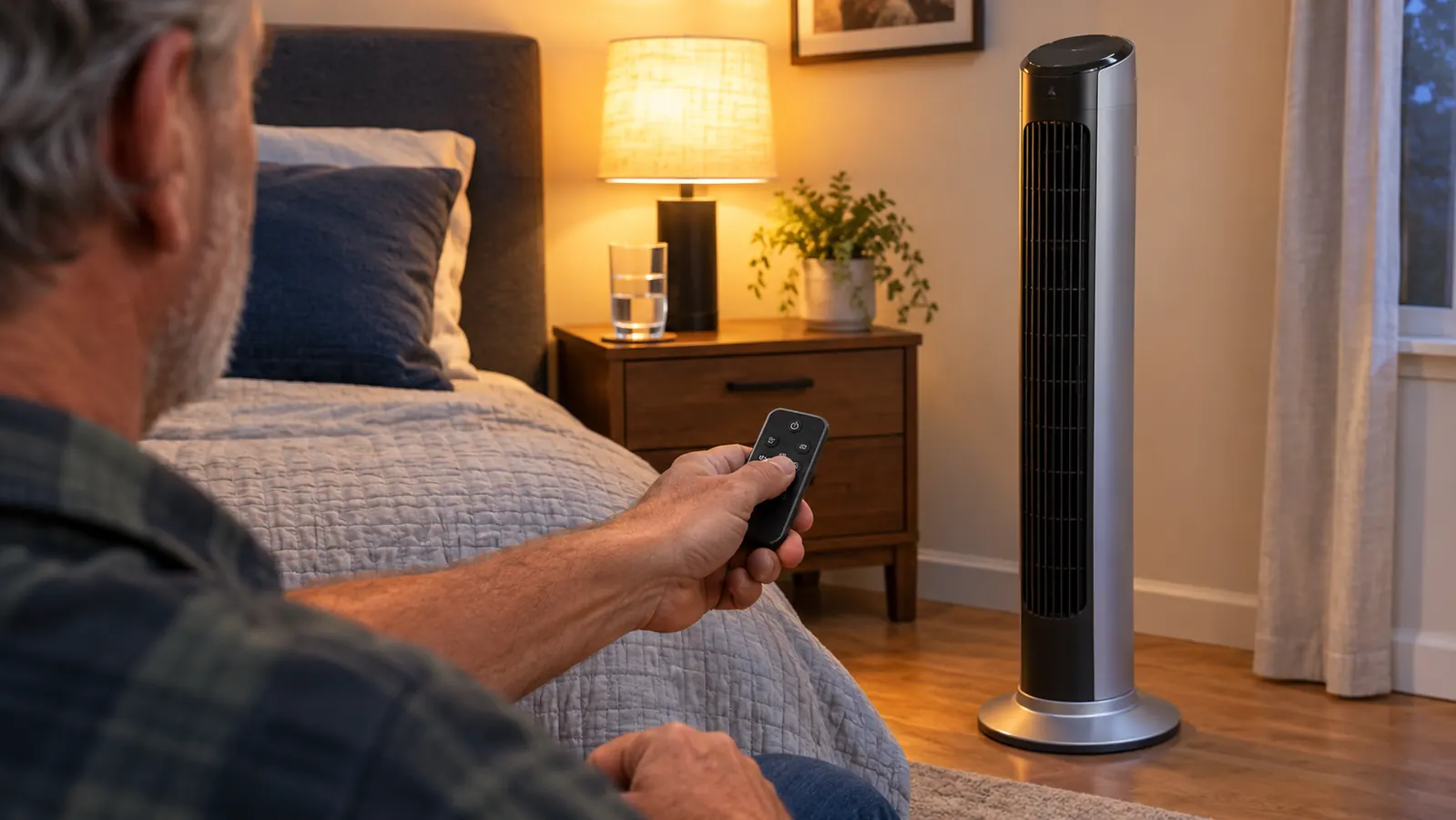
This fan has a remote and touch controls on the unit, and the remote is the part that actually changed my nights. Keep it on the nightstand where your hand falls, not in a drawer. That way a 3am adjustment takes three seconds and you never have to stand up.
The other tool is the 8 hour timer. Two ways to use it, and I have used both. The first is to set it for two hours when you get into bed, so the fan handles the hot stretch while you fall asleep and then shuts off, which keeps the room from getting too cold by dawn. The second is to set the full eight hours on a hot night and let it run through. I do the two hour version in spring and the eight hour version in July and August, when our west-facing bedroom never really cools down.
Step 5: Take the Room Down With It
A fan does not lower the temperature of a room. It moves air over your skin, and that is why it works. So the more you can do before bedtime to drop the actual heat in the room, the less the fan has to fight.
Keep the blinds or curtains closed on that west wall through the afternoon, before the sun hits it. That single habit did more for our bedroom than anything else I tried, because once the brick and the drywall absorb heat, they hold it into the night. Open the window on the cool side of the house in the evening if you have one, and let the fan pull that cooler air through. Turn off lamps and electronics that throw heat. Keep the thermostat where your doctor-approved routine has it; ours is at 68 at night and I do not touch it.
Then, and this is the part nobody likes, dress for it. A light cotton nightgown and a single sheet on your side of the bed, with the heavier comforter on Dale's side. Two different blankets on one queen bed is not a compromise, it is just correct.
What Else Helps
Beyond the fan, a few small things are worth trying and none of them cost much. A cool shower before bed drops your skin temperature for a while, and going to bed slightly cool helps you fall asleep. Keep a glass of cold water on the nightstand so you do not have to walk to the kitchen, because the walk is what wakes you the rest of the way up. A damp washcloth on the back of your neck for the worst nights is unglamorous and works surprisingly well.
Track it for two weeks. Write down what time you woke up, roughly how hot you were, and what the fan was set to. I did this with a notepad on the nightstand and it told me more than any article did, because the pattern in my own nights was not the pattern I assumed. Mine were worse on the nights I had a glass of wine and on the nights the daytime high had been over 90.
One thing I will say plainly, because it is not my place to say more: night sweats and broken sleep in menopause are common, and they can also be a sign of something that needs a doctor's attention. Talk to your doctor about what you are experiencing, and about hormones or medication if that is a route you are considering. A fan is a comfort tool. It is a good one, and it is not a treatment.
A fan does not cool the room. It cools your skin. Once I understood that, I stopped putting it in the corner and started putting it where it could actually reach me.
The Setup, In One Pass
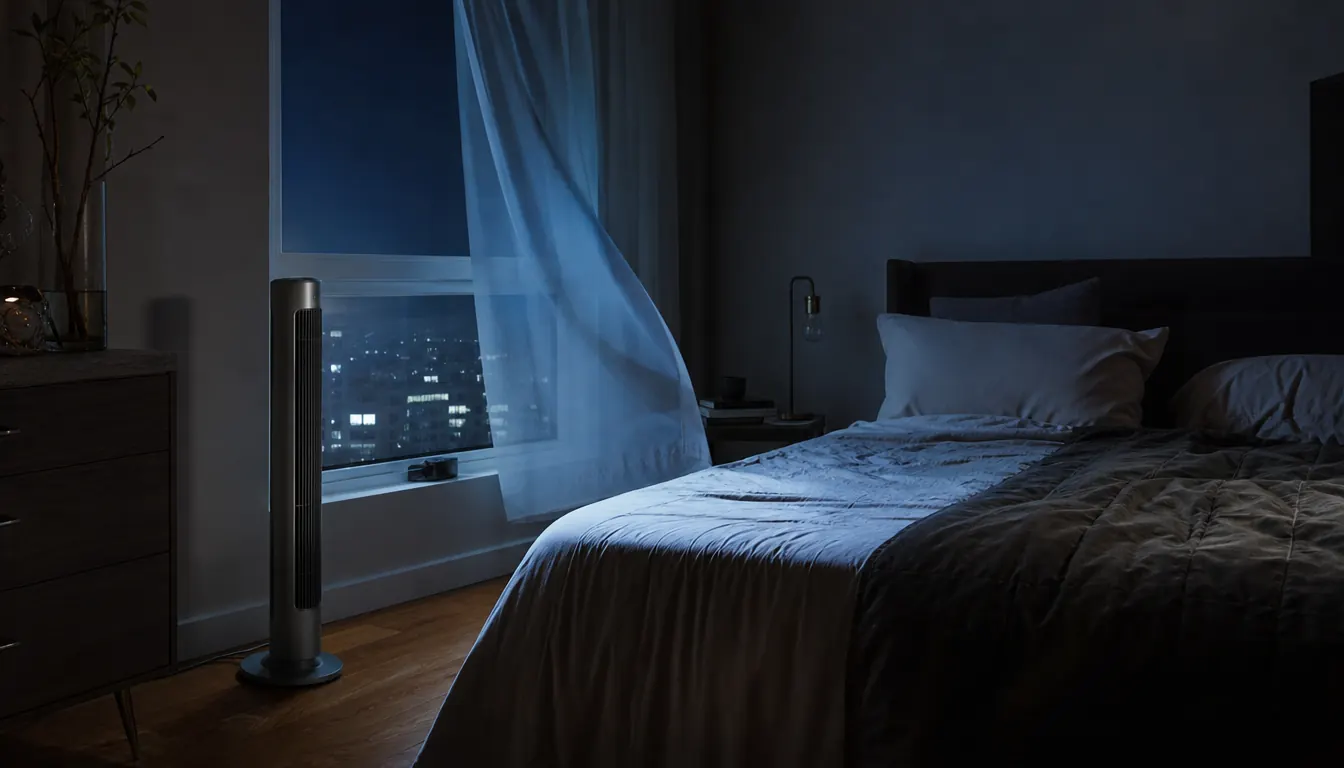
Two to four feet from your side of the bed, on the floor beside the nightstand, tilted up and angled across your upper body, never straight at your face. Four speeds, and you want the lower ones at bedtime. Remote on the nightstand within reach. Timer set for two hours in mild weather, eight hours in a heat wave. Blinds closed on the hot wall all afternoon. Sheet on your side, comforter on his.
That is the whole thing. It took me about a month of bad nights and one friend's advice to get there, and it is the difference between lying awake doing math about whether to get up and sleeping through until morning. The DREO tower fan is a good fit for this setup because it is quiet on the low settings, tall enough to reach shoulder height from the floor, and comes with a remote you can keep by the bed. Those three things are most of what a bedroom fan needs to do.
Quiet on the low settings, tall enough to reach you, remote by the bed
28dB on quiet, 36.26 inches tall, four speeds, 90 degree oscillation, and an 8 hour timer for the nights that will not cool down.
Amazon See the DREO Tower Fan on Amazon →