
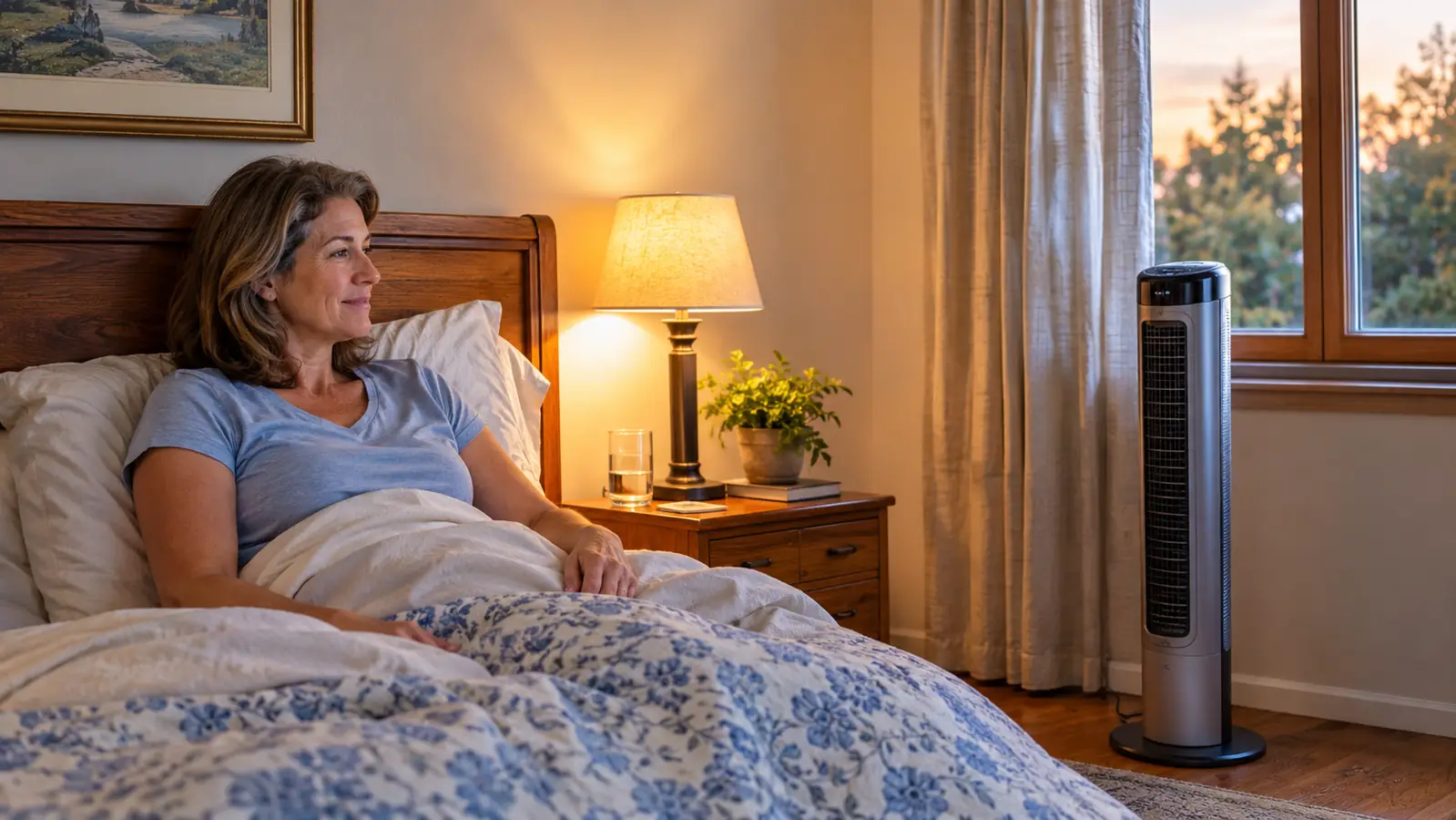
There is a specific kind of tired that comes from waking at 3 a.m. already too warm, throwing the covers off, then pulling them back on twenty minutes later because now you are cold and damp. I am 54 and I have been doing that dance for about three years. Our bedroom faces west and holds the afternoon heat like a brick oven, and Dale runs cold, so the heavy comforter stays on his half of the queen bed no matter what season it is. What finally helped was not a bigger air conditioner. It was a tower fan on my side of the bed, moving air across me and nothing else. The one I use is a DREO.
I am not going to pretend a fan fixes hormones. It does not, and that is a conversation for your doctor, which is exactly where mine is. What a fan does is make the room survivable in the ten minutes when your body is deciding whether to dump heat. The DREO does that without announcing itself, and that is the whole trick. Small thing. Turns out to be a large thing at 3 a.m. Here is what actually mattered to me, in the order I noticed it.
One fan, my side of the bed, and the first full night in months
The DREO tower fan is the piece of gear I stopped thinking about, which is the highest praise I can give a bedroom appliance.
Amazon Check today's price on Amazon →Air moving at 26 ft/s that you feel the second it reaches the bed
The first thing I noticed was air arriving from across the room. The spec is 26 ft/s at the vent, and whatever it is by the time it crosses four feet of carpet, it is still enough to feel on your face. That matters more than it sounds. A still bedroom feels warmer than the thermostat says, because your body sits inside its own little cloud of heat. Move the air and the cloud goes. I turn it on, lie back down, and my skin stops buzzing inside a minute or two.
Four speeds, and speed one is the one you will actually sleep with
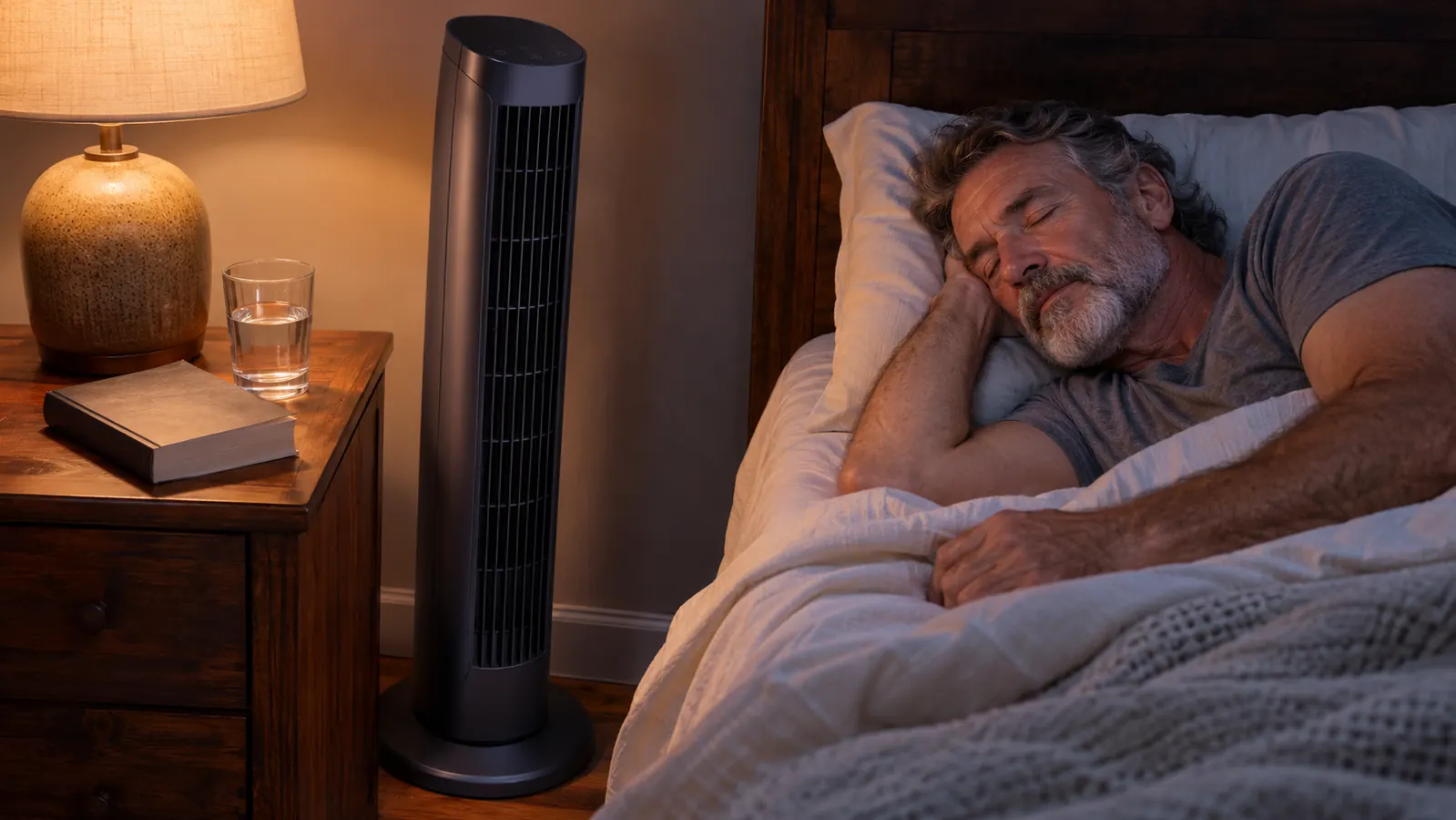
My old box fan had three settings: loud, louder, and jet engine. The DREO has four speeds, and the slowest is genuinely slow. That is the setting I use from the moment I get into bed, because it keeps air moving without turning the room into a wind tunnel. I bump it up only when I wake already hot at 2 a.m. and need to bring my temperature down quickly. Then I knock it back to one and go back to sleep.
28 dB is quiet enough that Dale never wakes up
The listing says 28 decibels, which is a number I could not picture. What I can tell you is that I can hear Dale breathing across the room, and I cannot hear the fan unless I stop and listen for it. That distinction matters when you share a bed with someone who does not wake up hot and would very much like to keep sleeping. I have switched it on in the middle of the night maybe forty times in a year. He has complained zero times.
90 degrees of sweep covers the whole bed, not one shoulder
Oscillation is the feature I did not expect to care about. A fixed fan dries one shoulder and leaves the rest of you warm. Ninety degrees of sweep moves air across the pillows and down the length of the bed, so you are not cooling one patch of skin and leaving the rest to fend for itself. If you sleep on your side and turn over twice a night, this is the difference between comfortable and clammy. I leave it on the wide sweep all night.
An 8-hour timer that shuts off before the house cools on its own
The timer runs up to eight hours, which is roughly my night on a good week. I set it when I go to bed and it turns itself off around the time the house starts cooling down anyway. There is something quietly pleasant about not having to think about it, and about not waking at 5 a.m. to a fan still running in a room that is now too cold. I used to let a fan run all night and pay for it at dawn. This is better.
A remote on the nightstand beats groping for a button in the dark
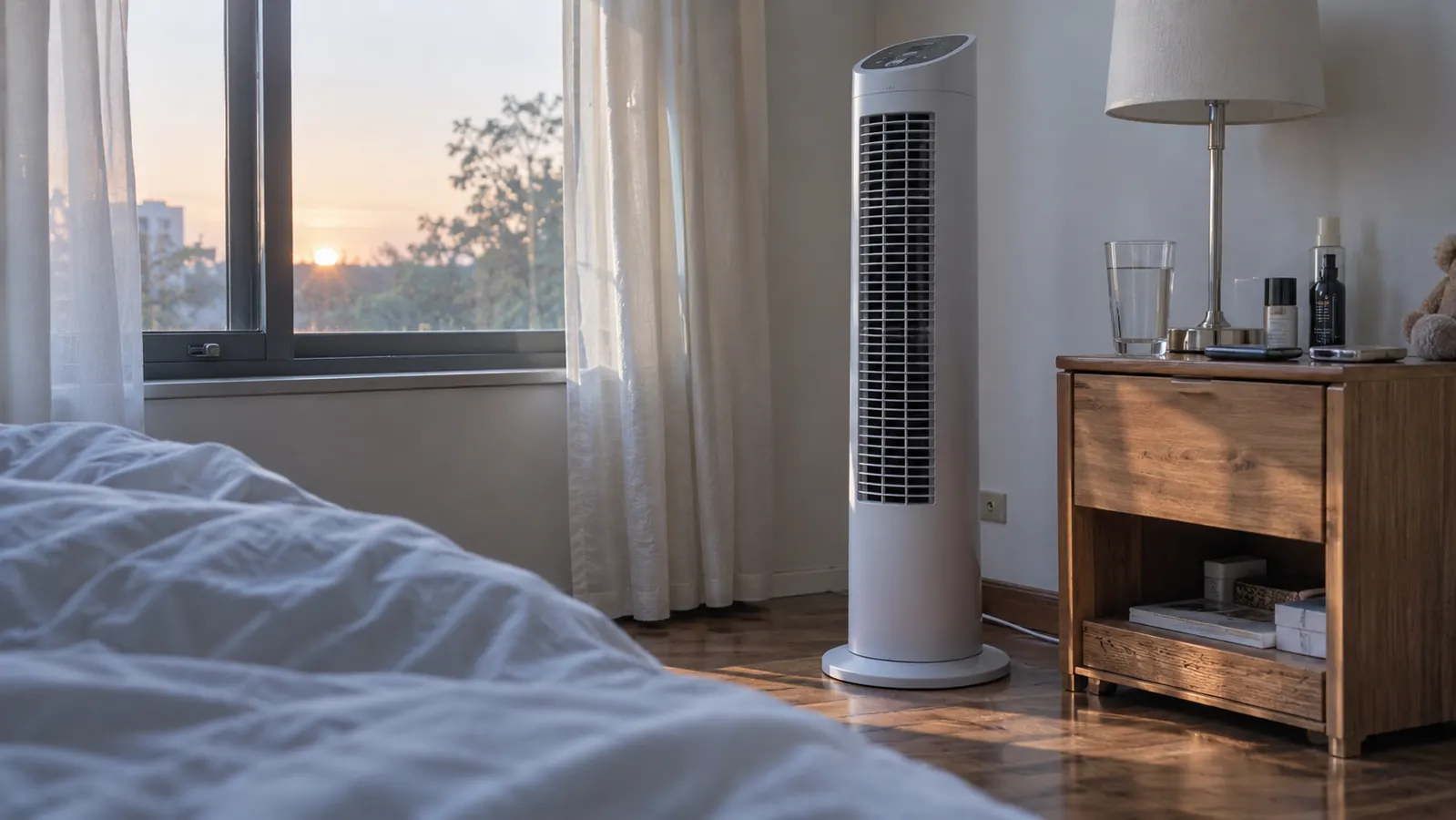
The remote lives on my nightstand, and the DREO also takes touch commands on top if I would rather not hunt for it. In the dark, with one eye open, I can find the remote by feel and tap the speed down without turning on a lamp. That sounds like a small thing. It is not a small thing at 3 a.m., when you are trying to drift back off and any excuse to fully wake up is a bad one.
36 inches tall, so the air lands on the mattress instead of your ankles
It stands about 36 inches tall, which puts the air outlet above the mattress rather than down at the floorboards. My old fan sat on the rug and did nothing but chill my feet. This one sends air where my shoulders and neck actually are, which is where I overheat first. If you have ever kicked off the covers and lain there with only your feet out because that was the one part that felt cool, this is the problem height solves.
8.4 pounds means you carry it to the kitchen with one hand
It weighs a bit over eight pounds, and the shape means I can move it from the bedroom to the living room one-handed. I take it to the kitchen more than I expected, mostly in August while I am standing over the stove. It is not furniture. You pick it up and put it where you are. That portability is the reason it earns its floor space in a small house instead of sitting in a closet ten months a year.
33 feet of reach handles a room where the bed sits far from the window
Airflow reaches up to 33 feet, which sounds excessive until you are in a bedroom where the bed is on the far wall from the window. Our west-facing room has the window at one end and the headboard at the other, and the DREO sits between them aimed back toward me. On speed two it reaches the head of the bed without trouble. You do not have to plant it next to your face, which I prefer.
An 8-inch footprint slots into the gap by the nightstand
The base is about eight inches across, so it fits the narrow space between my nightstand and the wall and stops being furniture. Nothing got moved to make room for it. That was the deciding factor for me, honestly, because I did not want to rearrange a room that has been the same way for fifteen years. It is corded, so it needs to sit near an outlet. Ours is behind the nightstand, which worked out fine.
What I'd Skip
Before you buy anything, know what did not work for me. A ceiling fan just stirred warm air around and made a clicking noise all night. Cooling pillows felt cold for about ten minutes and then matched my body temperature. A wet washcloth on the back of the neck helped for exactly as long as it stayed wet, which was not long. Sleeping with the air conditioning turned way down left Dale miserable under two blankets, and I still woke up hot. The DREO is the only thing in that list I still plug in every night, and it is the only money I would spend again. And anything marketed as a fix for night sweats themselves deserves your skepticism. A fan is a comfort tool. It moves air. Talk to your doctor about the rest, especially if you are considering hormones or medication. That is not a job for a bedroom appliance.
At 28 dB I can hear Dale breathing across the room, which is how I know the fan is not what wakes me up.
If you are tired of the 3 a.m. cover dance, start with moving the air
Four speeds, a wide sweep across the bed, and a timer that quits before dawn. Comfort, not a cure, and that is all I ever needed the DREO to be.
Amazon Check today's price on Amazon →