
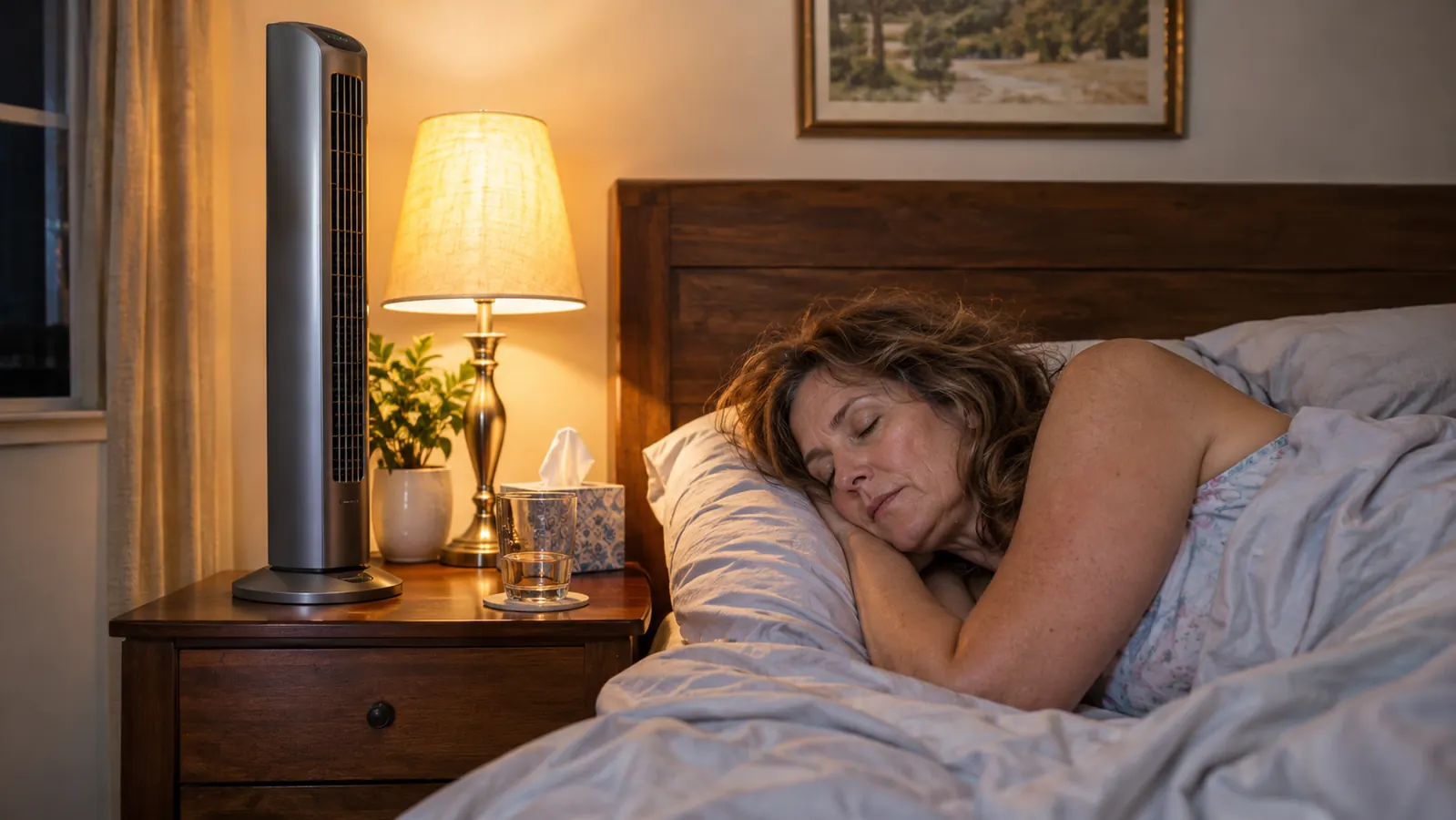
The first thing I do when I wake up hot at 3 a.m. is reach for the remote on my nightstand. For the last four months, that remote has belonged to a DREO tower fan. I am 54, I have been in menopause for about three years, and my bedroom is the warmest room in our single story brick house in Knoxville. It faces west, so the afternoon sun loads it up and the thermostat at 68 at night does not undo all of it. Dale runs cold and sleeps under a heavy comforter. I sleep on the other side of the queen bed with a thin sheet and, until this spring, a bad attitude.
I did not want a tower fan. I wanted the hot flashes to stop. My doctor handles the medical side, and I handle the room. That distinction matters. A fan is not a treatment. It is a comfort tool, and the DREO Tower Fan is the one I ended up using every night from the first week of June through the end of September. This is what a whole season of sleeping beside it was actually like.
The Quick Verdict
A quiet, tall tower fan that made my side of the bed bearable on hot nights. The 28 dB low setting and the 8 hour timer earned their place. The remote is small enough to lose, and the fan will not cool a whole room on its own.
Amazon Check Today's Price →The Fan That Made 3 A.M. Feel Less Like a Defeat
If your bedroom holds heat and you wake up already sweaty, this is the fan I kept beside the bed all summer. It is not a cure for night sweats. It is a way to get back to sleep without opening every window in the house.
Amazon See the DREO Tower Fan on Amazon →How I've Used It
I set the DREO on my nightstand in the first week of June. It is 36.26 inches tall and weighs 8.4 pounds, so it stands above the mattress line and moves air across my face and shoulders instead of into the side of the bed. The fan measures 8.03 inches deep and 8.03 inches wide, and that size fit on the nightstand once I moved my lamp to the dresser. I carried it to the living room twice during heat waves and back again at bedtime. At 8.4 pounds, that is a one hand carry, not a project.
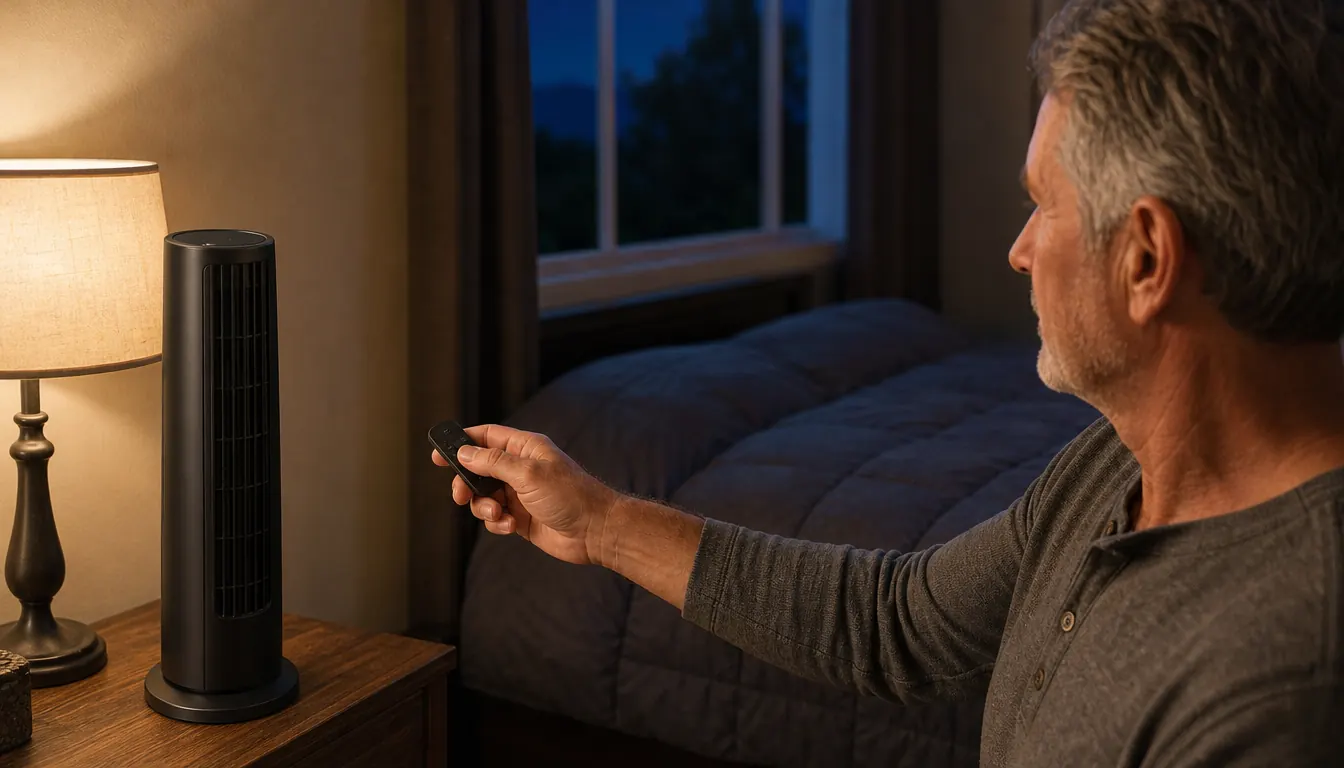
My routine settled fast. Around 9:30, I turn it on speed 2 and set the oscillation to sweep 90 degrees across the bed. I press the 8 hour timer, put the remote beside my water glass, and get in bed. When I wake at 3 a.m., which still happens, I use the remote to bump it to speed 3 for a few minutes. Once the sheet stops sticking to me, I drop it back to speed 2. That small sequence is the whole reason I kept it.
Dale hates direct air on his face. The 90 degree sweep keeps the airflow moving rather than parked on him, and on speed 2 he does not complain. On the nights I tried speed 4, he rolled over and pulled the comforter up to his chin. I do not use speed 4 at night anymore. That is not a fault of the fan. It is a fact about two people sharing one queen bed with different internal thermostats.
Before this fan, I tried a box fan in the window and a small clip fan on the headboard. The box fan was loud and pulled in the smell of the driveway. The clip fan moved air about as far as my chin. The DREO sits in the middle: more reach than the clip fan, less noise than the box fan, and a footprint small enough for the nightstand. That is the comparison I would make if we were standing in my bedroom.
The Airflow at 3 A.M.
The spec I care about at 3 a.m. is not a marketing number. It is whether the air reaches me when I am lying flat and overheated. The DREO is rated at 26 feet per second and 33 feet of reach. In our bedroom, which is roughly 12 by 14 feet, that is more than enough. I put the fan about 6 feet from my pillow. On speed 2, I feel steady air on my face and arms within seconds. On speed 1, I feel it mostly on my hands and the sheet. On speed 3, the sheet lifts and the air reaches the far wall. On speed 4, it is a lot. I have used it to dry a damp patch on the rug after a plant leaked, but not to sleep.
The 26 feet per second figure is the top speed, not the speed I sleep on. I say that because it is easy to read a number and expect a gale on setting one. On speed 1, the DREO is a soft move of air. On speed 2, it is a steady breeze. On speed 3, it is strong enough to lift the corner of a sheet. On speed 4, it is the fan I use when I am cleaning or when I have just come in from the garden.
The 90 degree oscillation matters more than I expected. A fixed fan makes one spot cold and leaves the rest of the bed warm. The sweep moves the air across my side and back toward the middle, so I get a break between passes. That break is what makes it feel like a breeze instead of a blower. I tried pointing it straight at my face for two nights. By the second night, my eyes felt dry and my nose was stuffy. The oscillation fixed that.
The airflow also reaches the far side of the room. I can feel it on my ankles when I sit at the small desk by the window. That is the 33 foot reach in practice, though I have not measured it with a tool. What I can tell you is that the fan moves air past the bed, across the dresser, and into the hallway if I leave the door open. It does not cool the air. It moves it. On a 90 degree Knoxville evening, moving air is the difference between lying still and lying there miserable.
The Controls I Actually Touch
I use three controls: power, speed, and oscillation. The DREO has four speeds, a 90 degree oscillation sweep, and an 8 hour timer. It comes with a remote and two AAA batteries. The fan also has touch controls on the unit. I use the remote 95 percent of the time because it lives on the nightstand and I do not have to sit up. The touch controls are there when the remote goes missing, which it has twice.
The 8 hour timer is the feature I did not know I needed. I set it once before bed and the fan shuts itself off while I am asleep. That means it is not running all day if I forget, and it is not blowing on me at 7 a.m. when the room has cooled. The catch is that 8 hours is the maximum. I usually sleep about 8 and a half, so on the hottest nights the fan clicks off before I get up. I have learned to turn it on again when I wake at 3 a.m., or to set the timer later in the evening.
The remote is small. It is easy to lose between the mattress and the frame, and it does not float. I solved that with a small dish on the nightstand. The buttons are simple enough that I can use them in the dark without turning on a lamp. I cannot say the same for every remote in this house. The two AAA batteries that came in the box lasted the whole season, which I did not expect.
What a Whole Season Changed
A season is a better test than a week. By August, I had stopped thinking about the fan as a new gadget and started treating it like a part of the room. The plastic housing wipes clean with a damp cloth, and the fan has not scratched the nightstand. I have not heard a rattle or a tick. The fan has run for hours on most nights, sometimes all night, and it still starts on the first press. I did not take it apart to clean the inside, and the manual that came with it is a quick start guide, not a repair manual.
What changed most was my reaction to waking up hot. Before the fan, a 3 a.m. wake up meant a trip to the kitchen for ice water and a walk around the house to cool down. That walk usually woke me up for good. With the DREO on the nightstand, I can reach over, bump the speed, and stay in bed. Sometimes I am back asleep in five minutes. Sometimes I am not. But I am not standing in the kitchen at 3:20 a.m. resenting the weather. That is a real improvement in a bad night, not a cure.
I should be clear about what the fan did not do. It did not stop night sweats. It did not change my hormones. It did not make July feel like October. There were nights when the heat was in the mattress and the air felt useless. On those nights, I put a cold pack under my pillow and used the fan on speed 3. My doctor and I have talked about the medical options, and I follow that advice. The fan is the part of the room I can control.
I also noticed the fan helps with the airless feeling that comes before a storm. Knoxville gets those still evenings in July when the air sits. The DREO does not change the humidity, but it keeps the air from feeling stale. I have run it on speed 1 with the window cracked and felt more comfortable than I did with the window open alone. That is a small thing. Small things are what a bad night is made of.
The Annoyances Worth Knowing
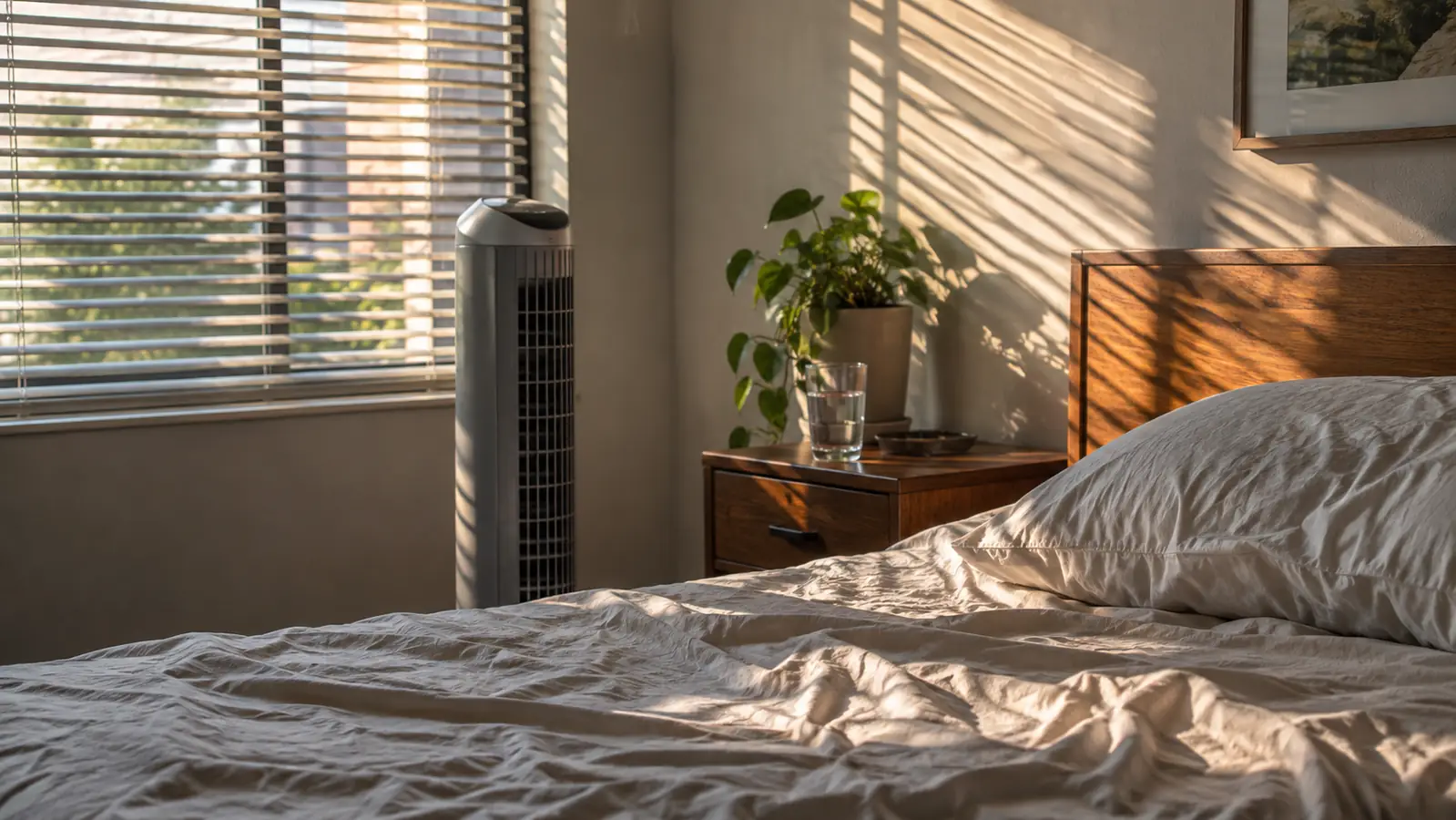
The biggest annoyance is the height. At 36.26 inches, the DREO does not fit under the low windowsill in our bedroom, and it will not hide behind a chair. It stands there like a piece of furniture. I stopped noticing it after a week, but if you want a fan that disappears, this is not that fan. The 8.03 inch footprint is small, so it does not eat the whole nightstand, but the tower itself is tall.
The second annoyance is the top speed. The fan is rated at 28 dB, and on the low settings it is quiet enough that I forget it is running. On speed 4, it is not 28 dB. I can hear it over the ceiling fan in the next room. That is fine for a hot afternoon, and it is why I do not use speed 4 at night. If you need a fan that stays whisper quiet on the highest setting, you will be disappointed. If you need a fan that can move a lot of air when you need it, the trade is fair.
The third annoyance is the cord. The fan is corded electric, so it has to live near an outlet. Our nightstand is close to one, which is why this worked. If your bed is across the room from every plug, you will need an extension cord or a different plan. The fan is portable at 8.4 pounds, but portable does not mean cordless. I carried it to the living room, plugged it in there, and carried it back. That is the limit of the portability.
The oscillation is 90 degrees, not a full sweep. On a queen bed, that covers my side and the middle. If you want air to reach the far corner of a large room, you will need to aim the fan or move it. I moved mine two feet closer to the bed in August and that solved it for me.
What I Liked
- 28 dB on the low settings, quiet enough to sleep beside
- 8 hour timer shuts off without me getting up
- 90 degree oscillation keeps air moving across the bed
- Four speeds, from a soft breeze to strong airflow
- Remote and touch controls, with two AAA batteries included
- 36.26 inches tall and 8.4 pounds, easy to move from room to room
Where It Falls Short
- Remote is small and easy to misplace
- 8 hour timer is shorter than a full night for me
- Speed 4 is audible, not whisper quiet
- 90 degree sweep is narrower than some fans
- Corded electric, so placement depends on an outlet
- Moves air, does not cool a room like an air conditioner
The fan did not fix my hormones. It fixed the three minutes after I woke up hot, and that is often the difference between a bad night and a survivable one.
Who This Is For
This is for the woman who wakes up hot and needs moving air on her side of the bed without turning the bedroom into a wind tunnel. It is for a shared bed, where one person runs cold and the other runs hot. It is for a west facing room that holds the afternoon heat and a thermostat that cannot go lower without a fight. It is for anyone who wants a timer, a remote, and a quiet low setting more than a smart app. The DREO Tower Fan fits that list for me. It is a comfort tool, not a treatment. That is the claim I would make to a friend.
Who Should Skip It
Skip it if you need a fan that cools the whole room like an air conditioner. Skip it if you need a timer longer than 8 hours, or if you cannot put it near an outlet. Skip it if you want a fan that disappears under a windowsill, because 36.26 inches is tall. Skip it if you need the highest speed to be silent, because it is not. And skip it if you are looking for a medical fix for night sweats. Talk to your doctor about that. This fan moves air. It does not change what your body is doing.
For the Side of the Bed That Runs Hot
I still keep the remote on my nightstand. I still wake up sometimes. But I do not lie there fanning myself with a magazine anymore, and that is worth something. If your room holds heat the way mine does, start with the fan and keep your doctor in the loop on the rest.
Amazon See the DREO Tower Fan on Amazon →