
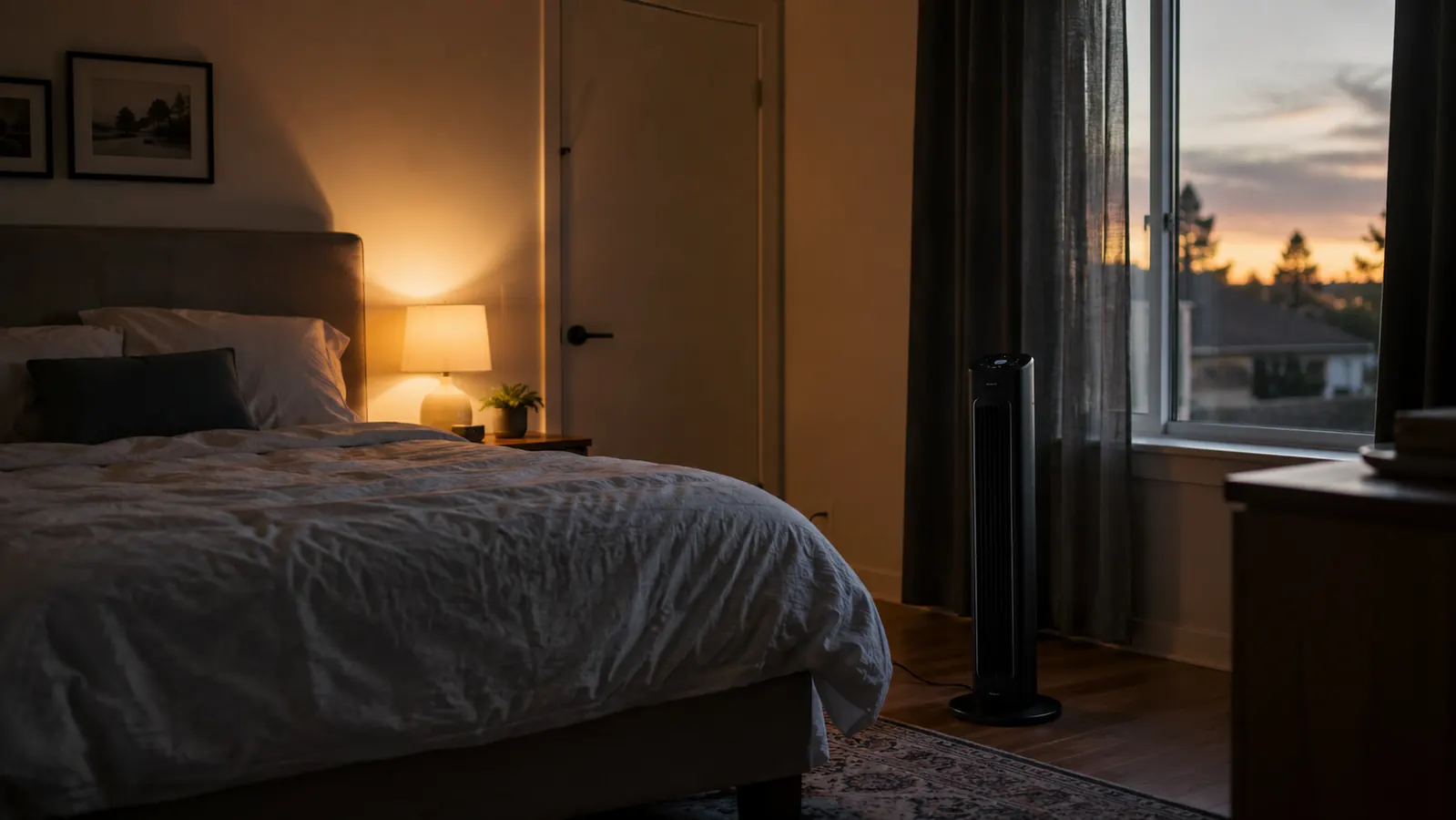
Short answer first. A ceiling fan moves more air around the whole room. A tower fan puts air exactly where you are. If you wake at three in the morning with a damp pillow and a husband who has already rolled into the cool half of the bed, the second one is the thing that gets you back to sleep. That is why the DREO tower fan ended up on my dresser and the ceiling fan stayed overhead, still useful, still turning, doing a broader and much less personal job.
I am not against ceiling fans. Ours came with the house and it earns its keep in July. But a ceiling fan cools a room. It does not cool a person. Those are two different jobs, and only one of them addresses the specific problem of a 54 year old woman waking hot at 3am on her own side of a queen bed. Once I stopped expecting the ceiling fan to do the tower fan's job, the whole thing got simpler and I stopped dreading the middle of the night.
| DREO Tower Fan | Ceiling Fan | |
|---|---|---|
| Aiming air at one side of the bed | 90 degrees of oscillation, and you can point the head at your shoulders and leave your husband alone | Moves air over both of you or neither of you, with no way to aim it |
| Air movement across the whole room | Strong for one spot on the floor, 33ft of reach, but it still starts from one corner | Circulates the entire room from above, which is exactly what it is built to do |
| Noise at pillow level | 28 dB on the low speeds, quiet enough that I stop hearing it | Varies a lot by motor and mount, and a slightly unbalanced blade is audible all night |
| Floor space used | 8.03 inches deep, 8.03 inches wide, 36.26 inches tall, so it wants a corner or a dresser top | None at all |
| Getting it into the bedroom | 8.4 pounds, out of the box and running in five minutes, no wiring and no ladder | An electrician, a ceiling box rated for the weight, and a day of your life |
| Control from bed | Remote and a touch panel, 4 speeds, and an 8 hour timer | Pull chain or wall switch, with a remote on some models |
| Air that does not blow straight at your face | Oscillation softens it, but it is still a directed stream and it can dry your eyes out | Overhead and indirect by design, which is gentler on the face |
| Winter use | Cooling only, and it makes no claim otherwise | A reverse setting pushes warm air down on most models |
| Renters and old wiring | Plugs into any outlet and moves house with you | A permanent fixture, and a rental lease may not allow it at all |
| Best for | Waking hot on one side of a shared bed at 3am | A room that is hot all over, all evening, before anyone gets into bed |
Where the DREO Tower Fan Wins
The entire reason a tower fan exists is aim. This one pushes air at 26 feet per second and the head oscillates through 90 degrees, so I can set it about four feet from the bed, angle it up toward my shoulders, and let it sweep across my side of the mattress without touching Dale's. He sleeps under a heavy comforter in January and complains if a window is open in October. A ceiling fan cannot make that distinction. It moves air over both of us or it moves none, and when he is cold, the compromise is always that I am warm.
I got to that arrangement the long way. The first summer after the night sweats started, I propped a box fan in the window sash and pointed it at the bed. It worked for about an hour, then the outdoor air turned warmer than the indoor air and it was blowing August into my face. The summer after that I tried a small clip fan clamped to the headboard. It moved air about eighteen inches and rattled against the wood every time it oscillated. Neither one was aim. Both of them were air moving somewhere near me and hoping. When I set the DREO on the floor at the foot of the bed on a Sunday afternoon in June and pointed it at the pillow from four feet away, the difference was obvious inside a single night.
The second thing it wins on is quiet. DREO rates this fan at 28 decibels, and on the low speeds that is roughly a quiet house with a refrigerator running somewhere in another room. I run it on speed two most nights and I stop noticing it inside of ten minutes. On the higher speeds it is audible, and I would not pretend otherwise, but you only want the top speed in the first hour before the room gives up its stored heat. There is an 8 hour timer, so I set it for the length of a night and it shuts itself off rather than running until dawn.
And it wins on the ordinary business of getting cool air into a bedroom that was never designed for it. It is 8.4 pounds and 36.26 inches tall. It plugs into the outlet behind my nightstand. Nobody has to come out and cut a hole in the ceiling, and if we ever move, it goes in the car with the lamps. Not every solution in a hot bedroom needs to involve a ladder, and at my age I have stopped finding ladders charming.
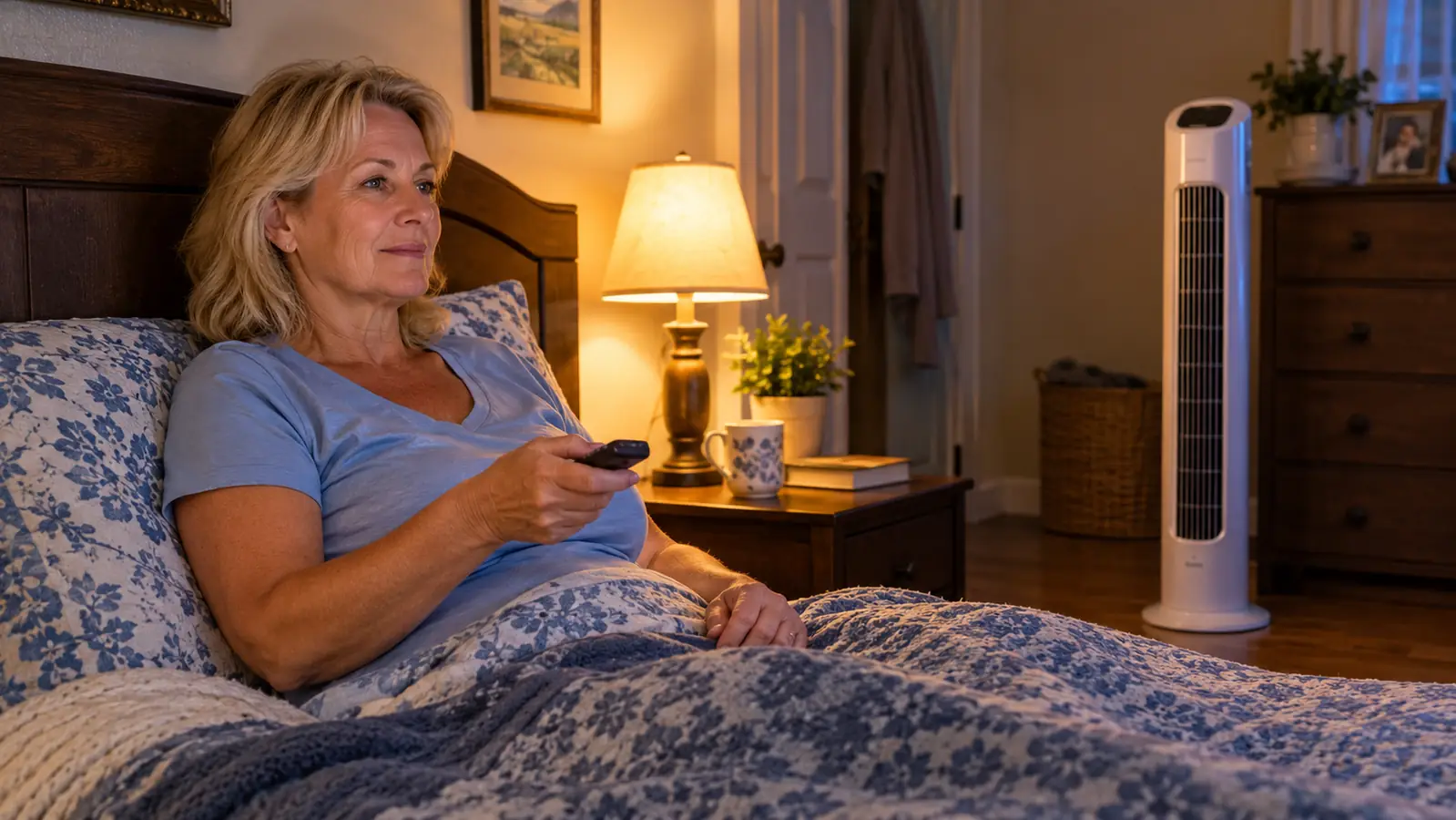
Where the Ceiling Fan Wins
Here is what I will concede, and I will concede it plainly. A ceiling fan circulates a whole room. On a still Knoxville evening in August, when the brick on the west side of this house has been baking since two in the afternoon and the heat has nowhere to go, the ceiling fan pulls the warm air off the ceiling and keeps everything moving. A tower fan tucked in one corner cannot do that, no matter how it oscillates. If your honest problem is that the entire room is unbearable, the ceiling fan is the better tool and I would tell you so at my own kitchen table.
It also takes up no floor space, which matters in a room where the dresser already has a fan, a lamp, a book, a glass of water and a phone charger on it. A ceiling fan keeps the floor clear and the sightlines clean. Mine also reverses, so in January it pushes warm air down instead of leaving it pooled at the ceiling. The DREO fan does not heat anything and does not pretend to. And nobody has ever tripped over a ceiling fan in the dark at 3am, which is more than I can say for anything that sits on the floor.
I will give you the specific evening that settled it for me on the ceiling fan's side. It was the second week of August, the thermostat was at 68 the way it always is, and the outside temperature had not dropped below 80 by ten at night. The brick on the west wall was still warm to the back of my hand. The tower fan was doing its job on my side of the bed and the room around it was still heavy and stale, and I could feel the ceiling holding heat maybe two feet above my face. I turned the ceiling fan on medium and the whole room changed in about four minutes. That is not a thing a fan on the floor can do, and I would be lying if I said otherwise.
A ceiling fan cools the room. It does not cool a person. Those are two different jobs, and only one of them helps at 3am.
If the heat is on your side of the bed, start there
The DREO tower fan weighs 8.4 pounds, plugs into the outlet behind the nightstand, and puts 26ft/s of air where a ceiling fan cannot aim. Four speeds, 90 degrees of oscillation, an 8 hour timer, and a remote you can find in the dark without turning on a light.
Amazon Check Today's Price on Amazon →The Night Sweat Problem a Fan Can Actually Help With
I want to be careful here, because I am not a doctor and this is not medical advice. Night sweats and 3am wake-ups are a menopause thing, and if yours are severe, talk to your doctor about what is available and follow that advice. A fan is a comfort tool. It does not fix a hormone and it will not stop a hot flash that is already happening.
What moving air can do is shorten the part afterward, the lying awake and damp, waiting for your body to come back down to normal. Moving air pulls heat off skin, which is why a directed breeze helps more than the same room at the same temperature with still air. When I wake hot, I reach for the remote, bump it to speed three, and I am usually back asleep inside fifteen minutes. Without it, I am on my phone at 3:40 in the morning reading about someone else's kitchen renovation, and the night is gone.
I can tell you what it looked like before. Two winters ago I was averaging four wake-ups a night, and I could recite the pattern the way you recite a phone number: 1:20, 3:05, 4:40, then the alarm at 6:15. My doctor knows about it and I follow her advice on anything medical, but the piece I could actually control myself was the temperature of the air on my skin. The first night I had the fan running on the low setting from bedtime instead of switching it on after I woke up, I slept straight through the 1:20 wake-up. That was the whole change. Not a cure, not a fix, just one fewer interruption, and one fewer is worth a great deal when you have been counting them.
The other half of it is Dale. We share one queen bed and he runs cold, so anything that cools the whole room becomes a negotiation I lose. Anything that cools my side of the bed does not require his opinion. That is the practical argument for directed air in a shared bed, and it has nothing to do with brand loyalty or how the fan looks. It is about whether I have to ask permission to be comfortable in my own bed at three in the morning.
The honest limitation is that a fan only buys you comfort, not relief. On the nights when a hot flash rolls through no matter what, the fan shortens the recovery and nothing more. I keep a folded towel on the nightstand and a spare pillowcase in the drawer, and I do not expect a small appliance to solve a bigger thing. What I expect is that it makes the aftermath easier, and this one does.
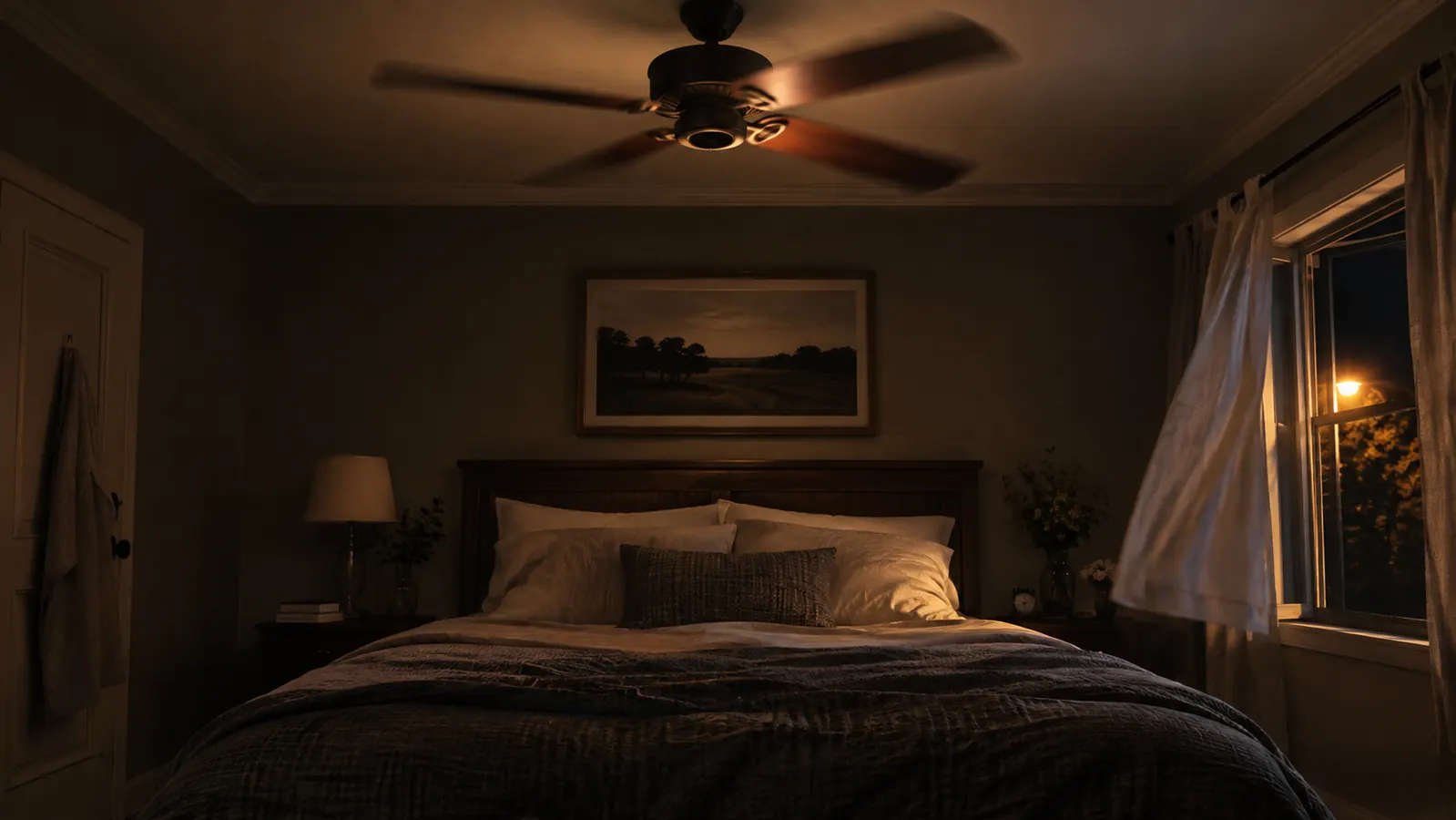
A Word About Placement
Where you put the thing matters more than which speed you choose. Our bedroom faces west and holds the afternoon heat, so the warmest air sits high and near the window. I keep the tower fan about four feet from the bed, angled slightly upward so the moving air arrives at my shoulders and chest instead of my face. Pointed flat at my face all night it dries my eyes out by two in the morning and I wake up feeling like I slept in a car with the vent on.
One more note, learned the hard way. Do not put the tower fan anywhere the air has to cross the footboard to reach you. Ours sat behind the footboard for a week and the solid wood cut the stream into two thin ribbons that missed my shoulders entirely. Shift it six inches to the side of the footboard and the air arrives whole. Same fan, same speed, and the difference was the difference between a good night and a bad one. It sounds fussy. It is not. It is six inches.
If you have both fans, as we do, use them for different halves of the night. The ceiling fan goes on medium when I come upstairs at nine and stays on until the stored heat is out of the room. Then it goes off and the tower fan comes on at speed one or two. That sequence handles the hot room, and then it handles the person in it. One appliance was never going to do both, and it took me two summers to work that out.
Who Should Buy Which
Buy the DREO tower fan if you wake hot on one side of a shared bed, if your husband runs cold and will not hear about a cooler house, if your bedroom is upstairs or west-facing and bakes all afternoon, or if you rent and cannot install anything permanent. Buy it if you want the remote on the nightstand and an 8 hour timer so you do not have to get up and switch it off at dawn. Buy it if the ceiling fan runs all night and you still wake up hot, because that is the tell that the air is moving everywhere except where you need it.
Spend the money on a ceiling fan instead if the room itself is the problem, if the heat is unbearable before anyone gets into bed, or if you have the ceiling height, the wiring and the inclination to install one properly. If you can have both, have both. The ceiling fan handles the room and the tower fan handles the woman in it, and the two of them together have done more for my sleep than anything else I have bought in the last three years.
Cool your side of the bed tonight, not the whole room
90 degrees of oscillation, 28 dB on the low settings, four speeds and a timer that shuts it off while you are asleep. If your bedroom holds heat and your husband runs cold, this is the smallest change that actually helps.
Amazon Check Today's Price on Amazon →