

The first honest thing I can tell you about the DREO tower fan is that it did not fix my sleep. It moved air. It ran quiet enough that I stopped noticing it after a week. And it kept my side of the bed from going damp by 3 a.m., which is more than the ceiling fan in this house has managed in three years. I am 54, three years into menopause, and I wake up hot most nights. This fan has been running beside my nightstand since spring. Here is what the listing does not tell you.
Most reviews of a bedroom fan are written the day it arrives. This one is written after months of nightly use in a west-facing bedroom in Knoxville that soaks up afternoon heat and gives it back all evening. Our thermostat sits at 68 at night and the room still runs warm. My husband Dale sleeps under a heavy comforter and I sleep under a sheet, which means cooling gear has to work on my half of a queen bed and leave his half alone. That is the standard I am holding this fan to.
The Quick Verdict
Quiet enough to sleep through on the low speeds, cool enough to matter at 3 a.m., and honest about what it is: it moves air, it does not cool the room.
Amazon Check Today's Price →A fan that is quietest on the speed you will actually sleep on
Four speeds, a listed 28 dB on the low end, and an 8 hour timer so it switches itself off while you are asleep. That combination is the reason this one stayed beside my bed.
Amazon Check Today's Price on Amazon →What Nobody Tells You About a Fan in a Hot Bedroom
A fan does not cool a room. It cannot, and no amount of marketing changes that. What it does is move air across your skin, which speeds up the way your body sheds heat, and that is the whole mechanism. Nobody prints that on the box because it sounds like a letdown. It is not a letdown. It is the difference between lying still and miserable at 3 a.m. and lying still and comfortable, and that difference is worth more than any feature list.
The second thing nobody tells you is that placement beats power. A tower fan at the foot of the bed on its highest setting does less for you than the same fan two feet from your shoulder on speed two. The DREO is 36.26 inches tall, so the air comes out at mattress height rather than blowing across the top of the bed or down at the carpet. That one detail is why I moved it out of the corner of the room in the first week and have not moved it back.
The third thing is that a fan on your side only works if it stays on your side. Dale does not want a breeze on him at 68 degrees and I do not blame him. The 90 degree oscillation is wide enough to sweep the entire queen bed, which is lovely in July and a negotiation by October. Most nights I run it fixed and aimed at my shoulder, and I turn the sweep on during the day when the bedroom has soaked up the afternoon and needs the air moved around.
I also learned that the fan has to be running before I get too hot, not after. Once I am overheated and my heart is going, a breeze takes twenty minutes to talk me down. If I start it at bedtime on low, the night is uneventful. If I wait until I wake up sweating, I lose an hour. That is not a product flaw, it is how bodies work, but it changed the way I use the fan more than any setting on it.
How I've Used It
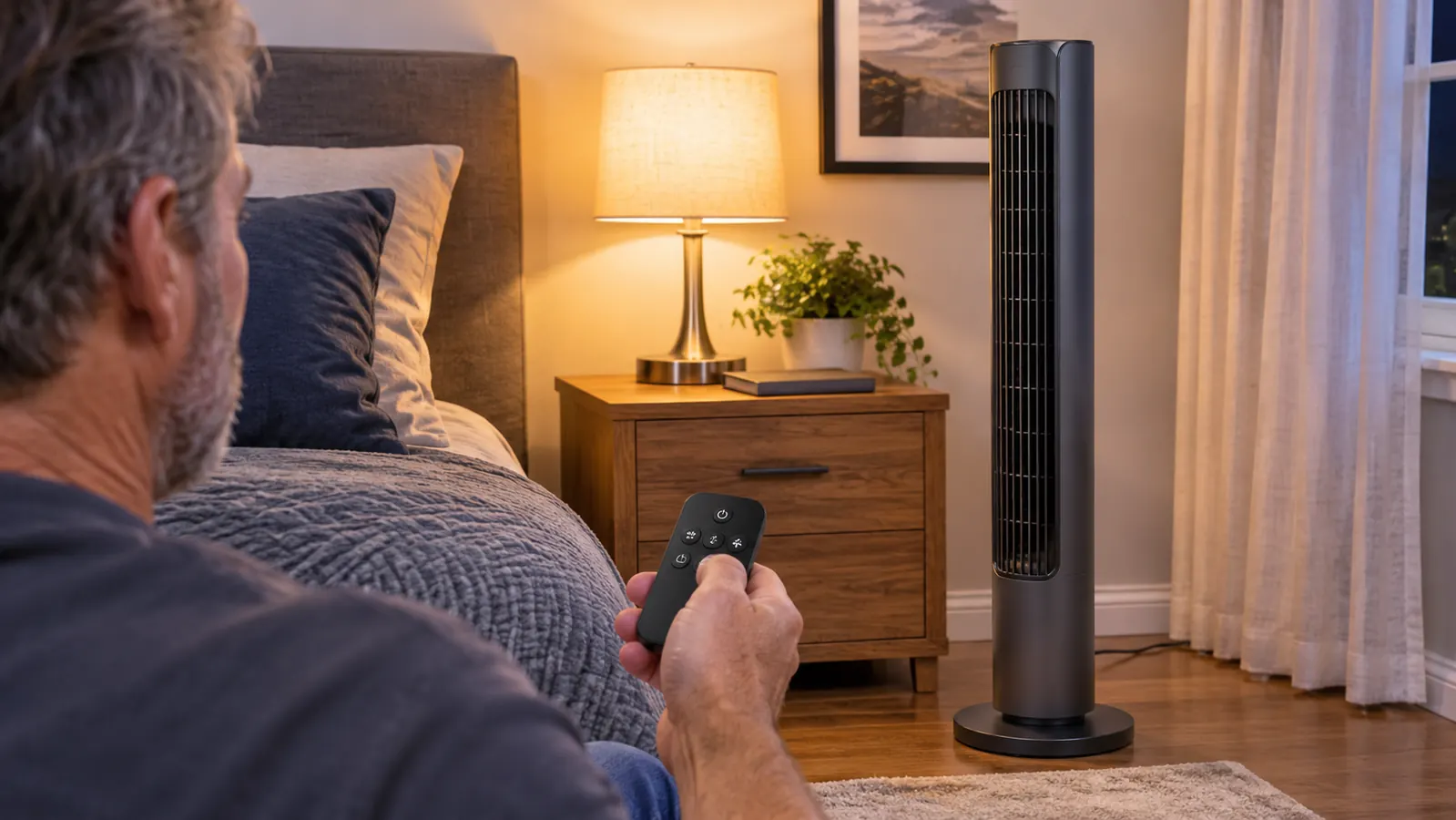
The fan sits on the floor between my nightstand and the wall. The base is 8.03 inches square, so it takes up less floor than my slippers, and at 8.4 pounds I can carry it to the living room with one hand when the west windows turn the front of the house into an oven. It is corded electric, so where it goes depends on where the outlet is. That is the trade you make for never thinking about a battery.
My routine is dull and it works. Sheet only. Thermostat at 68. Fan on speed two, pointed at my shoulder. Timer set short of the eight hour maximum. If I wake at 2 and I am too warm, I pick up the remote and go to three without sitting up, which matters more than it sounds like it should. That is the whole system. It is not a treatment for anything and I am not going to pretend otherwise. It is a way to get back to sleep instead of lying there fuming.
The first week I ran it on the highest speed because more felt better, and I slept worse. That is not the fan's fault. Four speeds exist so you can find the one that lets you fall asleep, and for me that is two. I would tell anyone buying this to start at one and work up, not start at four and work down.
The other adjustment was pointing it. Aimed straight up the bed it dries my eyes and my mouth by morning. Aimed at the wall it does almost nothing. Angled so it crosses my shoulder and chest on a slant is the spot, and the sweep setting helps me find that angle quickly before I fix it in place and leave it.
Noise: What 28 dB Actually Sounds Like
The listed noise level is 28 dB and my first thought was that this is a number invented for a spec sheet. It is not. On the lower speeds the fan is quieter than the house. I can hear Dale breathing. I can hear the refrigerator cycle on down the hall. I cannot hear the fan unless I stop and listen for it, and that is the only test that matters when the goal is falling back asleep at 3 a.m.
On the top speed it is audible. It is a steady rush of air, not a rattle or a whine, and I would call it louder than a ceiling fan on medium and easier to sleep through than a window unit. If you need white noise, speeds three and four will give it to you. If you need silence, stay low.
That 28 dB figure is the quietest setting, not the average. This is where a lot of reviews get slippery. A fan that whispers on low and roars on high is not lying, it is a fan with four speeds and a range. The honest version is that this one has a genuinely quiet bottom half and an ordinary top half. I have never needed the top half overnight.
It does not cool the room. It cools me. Once I stopped expecting the first thing, the second thing started working.
Airflow: 26 Feet Per Second and a 90 Degree Sweep
The airflow rating is 26 feet per second and the reach is 33 feet. I cannot verify either number with a meter and I am not going to pretend I did. What I can tell you is what it feels like. At three feet, which is where my shoulder is, speed two gives a steady breeze you can feel through a sheet. At the far end of the room, twelve feet away, I feel it on my face when the sweep comes around. That is more reach than the box fan we used to haul up from the garage every June.
The 33 foot figure is about moving air across a space, not about delivering a gale to your pillow. I carried it to the living room one afternoon when the west windows were doing their worst and it kept that room from feeling stagnant from about fifteen feet away. It is not air conditioning and it will not drop the number on the thermostat. What it does is keep the air from sitting on you.
The 90 degree sweep is wider than I expected. Across the bed it travels from my shoulder, over the pillows, and onto Dale's side, which is exactly why I usually leave it fixed. In the living room the sweep is the better setting, because the air keeps circulating instead of pounding one spot. Two different jobs, one fan, which is why mine moves between rooms.
The 8 Hour Timer, the Remote, and the Small Annoyances
The timer runs up to eight hours and I have never once used the full eight. I set it and forget it, and it switches itself off while I am asleep, so I am not waking at 4 to a cold room and a fan still running. That sounds like a minor line on a spec sheet. For me it is the difference between a fan I use every night and a fan I resent.
The controls are a remote and a touch panel on the fan. That is the whole list. There is no app, no Wi-Fi, nothing to pair, nothing to update, and nothing that quits working when the internet goes out. I know plenty of people want a fan they can start from the driveway. I want one that works in a thunderstorm, so this suits me.
The remote arrived with two AAA batteries in the box, which I noticed because every other remote in this house showed up empty. It lives on my nightstand now. When I have misplaced it, twice, the touch panel on the fan still works. I just have to get out of bed to use it, which at 3 a.m. is its own punishment.
The complaints are small and real. The remote is small enough to vanish into a drawer. The body is plastic and looks like a plastic tower fan, not a piece of furniture. And the step from speed two to speed three is a bigger jump than I would like on the nights when two is nearly enough and three is slightly too much. None of that has made me stop using it.
Three Details That Mattered More Than I Expected
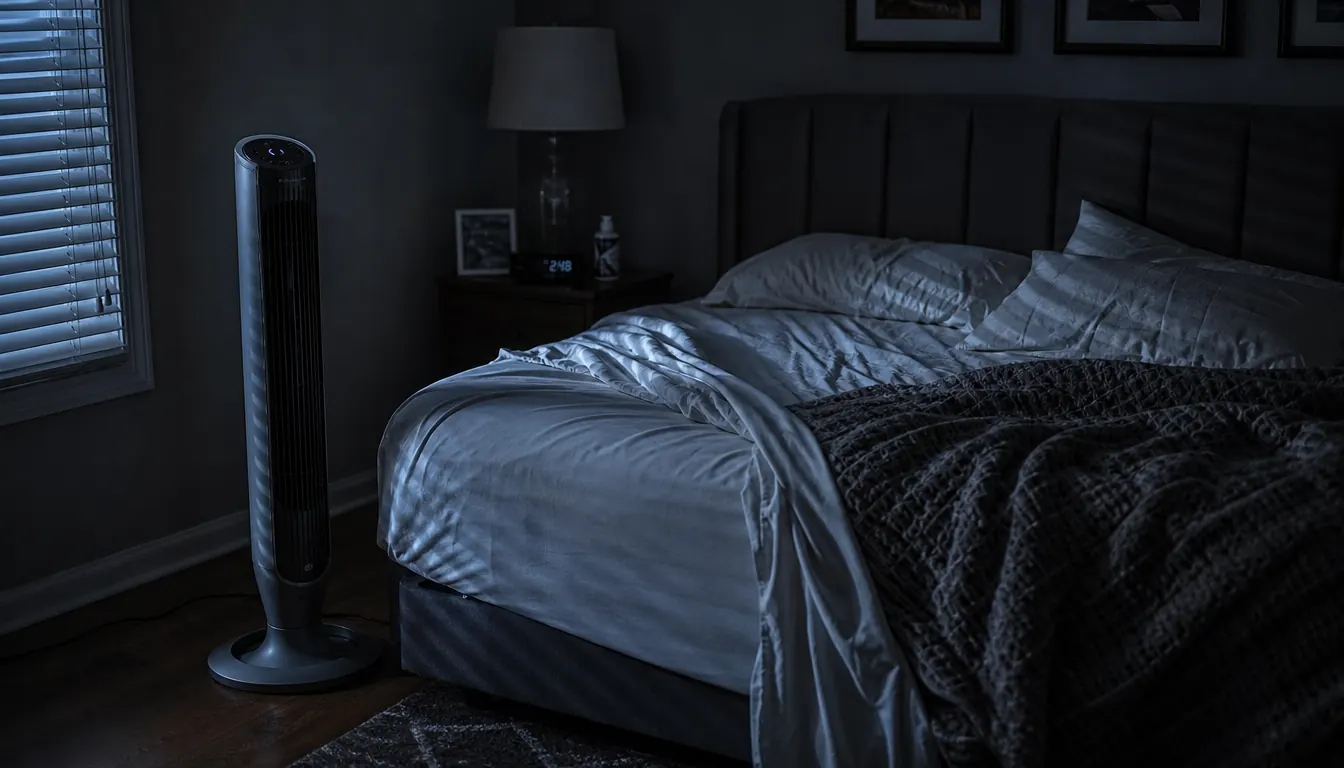
The height is the first. A 36.26 inch tower puts the airflow at the level of a mattress, and a fan that blows at mattress level reaches a sleeping body differently than one that blows over the top of it. I spent two summers with a small desk fan that cooled my ankles beautifully and my torso not at all.
The footprint is the second. The 8.03 inch base means the fan does not need a two foot square of clear floor, so it fits in the narrow strip between the nightstand and the wall where almost nothing else in this house fits. In a small bedroom that is not a small thing.
The third is the timer. I did not think I would use it. I use it every night. A fan that runs until morning leaves me pulling the sheet up at 5, which is its own small defeat, and a fan I have to get up to switch off is worse. Setting it and forgetting it is the most useful thing this fan does after the airflow itself.
What It Does Not Do
It does not lower the temperature of a room, and if that is what you are shopping for, no fan will give it to you. Menopause heat is not really about the room anyway. It is your body's thermostat misfiring, and a fan works on the surface of your skin while that passes. I say it plainly because I bought my first fan expecting more and spent a month disappointed by physics.
It does not go where the outlet is not. In an older house like mine the outlet situation is worse than the room situation, so the fan lives on one wall whether I like it or not. And it does not disappear. The tower shape means it stands on the floor, 36.26 inches of it, so it takes up space beside the bed rather than sitting on a dresser out of the way.
It also does not get smarter over time. There is no learning, no schedule, no automation. You pick a speed, you point it, you set a timer. That is the entire relationship. Some people will find that refreshing. Some will find it dated. Both are fair, and neither changes how it performs at 3 a.m.
What I Liked
- Listed at 28 dB, and genuinely quiet on speeds one and two
- Four speeds, so there is a low setting you can sleep through
- 36.26 inches tall, so the air reaches mattress height instead of the floor
- 90 degree sweep covers a full queen bed when you want it to
- 8 hour timer switches it off without you getting up
- Remote and touch controls, with batteries included
- 8.4 pounds with an 8.03 inch base, easy to carry between rooms
Where It Falls Short
- It moves air, it does not cool the room
- Audible on the top speed in a quiet bedroom
- Corded electric, so placement depends on the outlet
- Plastic body that looks like plastic
- No app, no Wi-Fi, no scheduling for anyone who wants it
- The jump from speed two to three is wider than I would like
Who This Is For
This is for the woman who wakes at 2 or 3 with her chest hot and her pillow damp, who has already tried a lighter blanket, a colder thermostat, and a ceiling fan that moves air over the bed instead of onto it. It is for a shared bed where one person wants a breeze and the other wants a comforter. It is for a bedroom that holds the afternoon heat and gives it back all night.
If that is your bedroom, this fan earns its floor space. And if your night sweats are frequent and severe, talk to your doctor about them. A fan is comfort, not care, and it should sit alongside the advice you get from someone who knows your history.
Who Should Skip It
Skip it if you want an app, a schedule, or a fan that answers to your phone, because this one does none of that. Skip it if the room needs actual cooling rather than air movement, since a tower fan cannot do that. Skip it if you need dead silence at the top speed, because no fan with four speeds and this much airflow is silent up there.
And skip it if the nearest outlet is behind the dresser on the far side of the room. A corded fan that cannot reach your side of the bed is just a floor stand with a remote you will lose. Measure the distance before you buy, not after.
Start at speed one, not speed four, and you will sleep better
That is the advice I would give a friend. The DREO tower fan has a quiet bottom half, a timer that ends the night for you, and a footprint small enough for the strip beside a nightstand.
Amazon Check Today's Price on Amazon →