

If you wake up at three in the morning with a damp neck and flip the pillow hoping to find a cool spot, the difference between these two pillows stops being a shopping question. The QUTOOL Cooling Pillow is a shredded memory foam pillow with a double-sided cover, and one of those sides is a silky ice fabric that the listing says lowers surface temperature by about 4 to 9 degrees Fahrenheit. A traditional memory foam pillow is a single molded block of foam inside a fabric cover. One of them was designed for a person who runs hot. The other was designed to hold a shape. That is the short answer, and the rest of this is the part that actually decided it for me.
I am 54, about three years into menopause, and I have slept on both. Our bedroom faces west and holds the afternoon heat, so by nine at night the room is still catching up with the thermostat set at 68. Dale runs cold and sleeps under a heavy comforter. I sleep on top of the covers with a fan pointed at my side of the queen bed. The molded memory foam pillow I used for years did one thing beautifully: it held the shape of my head. It also turned into a warm stone by about one in the morning, and once it warmed up it stayed warm until daylight. The QUTOOL pillow does not fix menopause. Nothing on a bed does. Talk to your doctor about anything hormonal and follow that advice. What this pillow does is give your head somewhere cooler to land, and for me that turned out to matter more than I expected.
| QUTOOL Cooling Pillow | Traditional Memory Foam Pillow | |
|---|---|---|
| Cooling | One side of the cover is a silky ice fabric that the listing says lowers surface temperature by about 4 to 9 degrees | Standard fabric cover over solid foam, warms where your head rests and stays that way |
| Fill | 85% cross-cut memory foam and 15% soft microfiber, shredded so it moves | One solid molded block, poured at a fixed loft |
| Adjustability | Fill can be taken out or put back until the height suits your neck | Whatever loft it was made at, for as long as you own it |
| Airflow | Shredded fill leaves gaps, so air moves through the pillow | Solid foam traps heat in one spot |
| First night | Listing says to let it air out for a day or two, and the fill takes a few nights to tune | Ready to sleep on the moment it comes out of the bag |
| Holding its shape | Needs a shake each morning and a fluff twice a week | Never needs re-fluffing or redistributing |
| Care | Cover is machine washable and air dried with no heat, the foam itself is never washed | Usually spot clean only, cover often not removable |
| Neck and spine | Cradles the head and neck and keeps the spine aligned when the fill is set right | Firm, even support with no tuning required |
| Best for | Hot sleepers who flip the pillow and want to change the loft | Sleepers who want one firm surface and no maintenance |
Where QUTOOL Wins
The cooling claim is specific enough to be worth repeating: the listing says the ice-silky side lowers surface temperature by about 4 to 9 degrees. I cannot put a thermometer to my cheek at two in the morning, but I can tell you how the two pillows feel. On the molded foam, my cheek was warm within twenty minutes and damp within an hour, and flipping it only gave me the same warm fabric turned over. On the QUTOOL, the ice side stays noticeably cooler for a long stretch. When it does warm up, the other side of the cover is a soft fabric, so turning the pillow over gives me a genuinely different surface instead of the same one in a different direction. Two surfaces, two different sleeps, one purchase. I started keeping a note on the nightstand in the middle of June, mostly out of irritation, writing down the time whenever I woke. On the molded pillow the first entry was usually somewhere around 1:10 or 1:20, and there was often a second one near 3:40. On the QUTOOL the first entry moved to between 3:00 and 4:00, and two or three nights a week there was no entry at all. Six weeks of pencil marks is not a study and I am not presenting it as one. It was enough to convince me I was not imagining the difference.
The second win is the fill. It is 85% cross-cut memory foam and 15% soft microfiber, shredded rather than molded, and you can get at it to take some out. I removed about two handfuls the first week because the pillow sat too high under my neck and pushed my chin toward my chest. With less fill it became a low, soft cradle that let my chin stay level. In February, when my neck was stiff, I put a handful back. There is no version of that conversation with a solid foam pillow. You get the loft it was poured at, and if that loft is wrong for your shoulders it stays wrong. The adjustable part is not a gimmick. It is the reason one pillow can work for a side sleeper and a back sleeper in the same house.
Shredded fill has gaps in it. Solid foam does not. That is the mechanical difference behind everything else here, and it is why the QUTOOL pillow weighs 3.3 pounds and shifts under your hand instead of sitting there like a sandbag. Air can move through a bag of small pieces in a way it cannot move through a poured block, so the heat coming off my head and neck does not pile up in one place the way it did before. I still wake up sometimes. I just wake up less often with the sheet stuck to my back, and when I do, there is a cool side waiting for me. Dale picked it up off the bed one evening and said it felt like a bag of rice, which is not wrong, and is also the reason it works. A solid block of foam has nowhere to send the heat except back into your face.
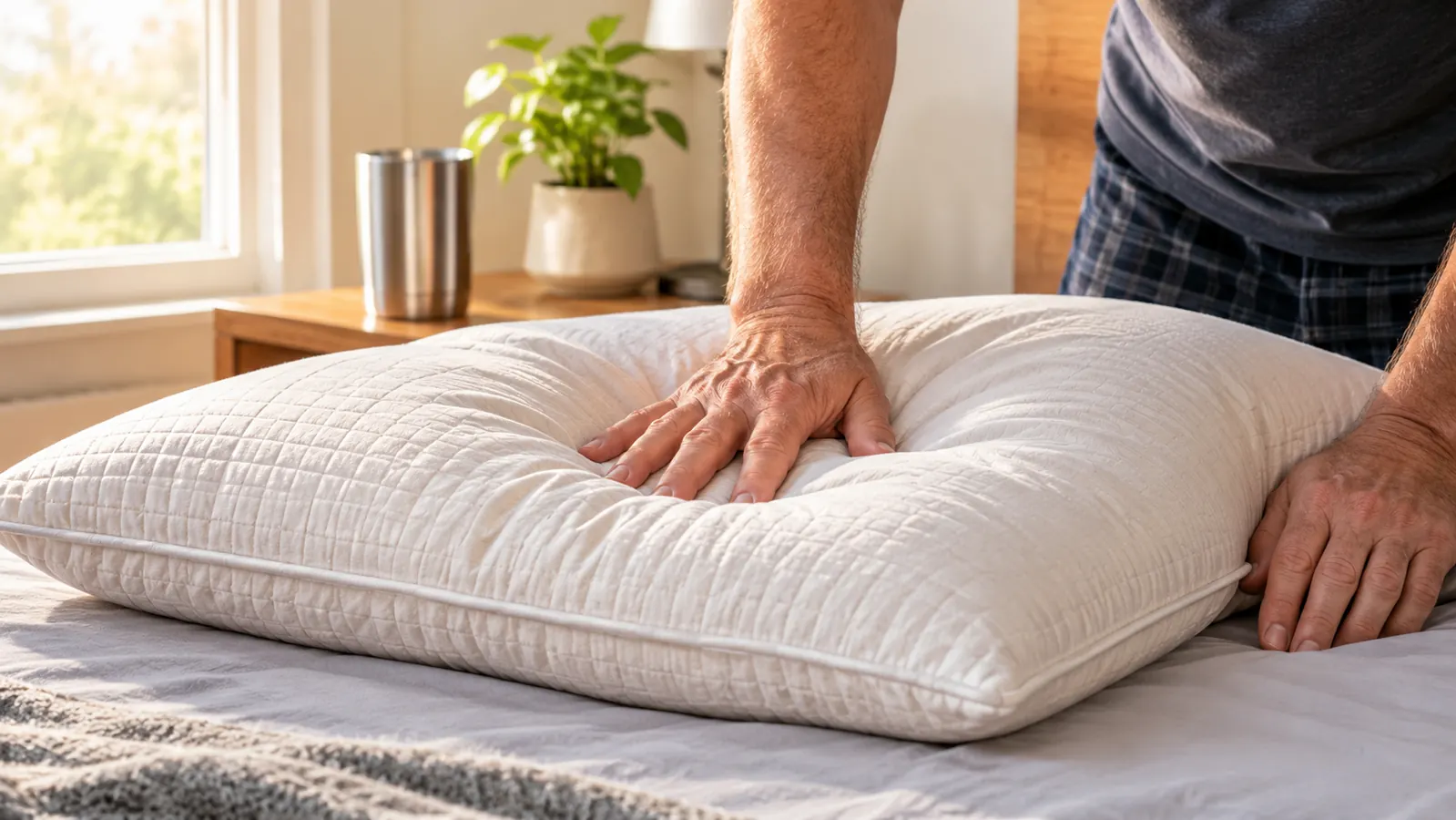
Where Traditional Memory Foam Wins
I am not going to pretend the molded pillow has nothing going for it. I slept on one for six years and I went back to it after every failed experiment. The first thing it wins is the first night. My QUTOOL arrived compressed, and the listing says to let it air out for about a day or two before sleeping on it. That is honest and it is also inconvenient. Mine came out of the box on a Thursday and I slept on it Friday, which was one day and not two. I should have waited. That first night it was overfull and too high under my neck, and I woke with a dull ache across the back of my head and told Dale I was sending it back. He talked me into giving it a week. By Monday I had taken some fill out and the ache was gone. If you are the sort of person who returns a thing on the second morning, know that going in. Molded foam is the pillow it is going to be the moment you take it out of the bag.
The second thing it wins is shape. Shredded fill settles. Mine needs a good shake every morning and a proper fluff twice a week, and if I skip that for several days it sleeps flatter than I like. I went a full week without fluffing it once and could feel the difference by Thursday, the fill pushed out toward the edges and the middle gone thin. Molded foam does not do that. It also gives you a firm, uninterrupted surface, and some back sleepers genuinely prefer that to the shifting feel of a shredded pillow. If you like a pillow that behaves like one solid object rather than a bag of small ones, the QUTOOL will feel fussy to you and the molded pillow will feel correct. That is not a flaw in either one. It is a difference in what you want at three in the morning.
If you are the one flipping the pillow at 3am, start with the side that stays cool
The QUTOOL Cooling Pillow has a silky ice side that the listing says lowers surface temperature by about 4 to 9 degrees, plus shredded fill you can add or remove until your neck is happy.
Amazon Check Today's Price on Amazon →What the Cooling Side Actually Does
The listing says this plainly and I appreciate it: all fabrics used on bedding are affected by the temperature of their surroundings. The ice side is not a refrigerator. If your bedroom is 82 degrees, the pillow will be about 82 degrees and no cover on the market changes that. What the fabric does is move heat away from your skin faster than a plain polyester cover, so you get a longer stretch of comfort before your own body heat catches up with it. In our house, with the thermostat at 68 and the fan on my side, that stretch is the difference between waking at one and waking at four. During the worst of the hot flashes, that extra three hours was the whole ballgame.
So here is how I would set your expectations. Do not buy this expecting to be cold. Buy it expecting to be less warm, for longer, and to have a second surface to turn to when the first one gives out. That is a smaller promise than some of the packaging language suggests, and it is the one that held up for me across a whole Knoxville summer. I also noticed the cooling is most noticeable when the room is actually cool. On a night when we forgot to drop the thermostat, the gap between the two pillows nearly closed and I was back to flipping like always. That was the second week of August, a Tuesday, after a day that had gone past 94. The bedroom never came down, the fan was only pushing warm air around, and I woke anyway at 2:30. The ice side was still the better of the two. It just was not magic, and I would rather tell you that now than have you find out on a bad night.
On the molded foam my cheek was warm in twenty minutes. On the QUTOOL the ice side is still cool when I wake at four.

The Fill, the Cover, and the Care Instructions
The cover is polyester with a 350 thread count, and the care instructions are the part people skip. The shredded memory foam itself does not get washed. You unzip the cover and machine wash the cover only, then air dry it with no heat. Mine goes over the shower rod on a Saturday morning and is dry by afternoon. The inner case that holds the foam gets spot cleaned. This is not a pillow you throw in the machine when someone in the house has a cold, and that is worth knowing before you buy rather than after. The first time I washed mine I ran it on a cold, gentle cycle and then hung it over the shower rod, and I fussed about it all afternoon, convinced I had ruined a pillow I had spent two weeks tuning. It came out fine and went back on exactly the same.
The fill is loose inside the inner case, which is why it moves and why it can be adjusted, and also why it can bunch at one end if you sleep with an arm under the pillow. A shake sorts it out. I keep a spare cover so wash day does not cost me a night on the warm side. Small thing, but the whole point of this pillow is the surface you put your face on, and I would rather not spend two nights a month without it.
Who Should Buy Which
Buy the QUTOOL if you are the person who flips the pillow. If you wake with a warm, damp patch under your cheek, if you sleep with a fan aimed at your side of the bed, if you have ever put a pillowcase in the freezer, this one was built with you in mind. It also suits anyone whose shoulders and neck have opinions about height, because the fill comes out and goes back in. A side sleeper who needs some lift and a back sleeper who needs very little can both land somewhere workable, which is more than I can say for a molded block.
Stay with a traditional memory foam pillow if you want the same firm surface every night with no maintenance, if you sleep cold, or if you like a high, solid loft and have never once wished your pillow were cooler. It is also the simpler choice if you do not want to spend a week tuning a pillow to your neck. Neither of these is a mistake. One of them is just more work than the other, and the work buys you a cooler surface and a fit you cannot get from something poured in a mold.
A cooler side and a loft you can change, in one pillow
The QUTOOL Cooling Pillow pairs a silky ice cover side with adjustable shredded memory foam fill. If hot nights are what wake you, this is the place to start.
Amazon See Today's Price on Amazon →