

The 3 a.m. routine used to go like this. Wake up with the sheet stuck to the back of my neck. Kick the comforter onto the floor. Lie there clammy and shivering at the same time. Pull it back up twenty minutes later when the chill set in. Repeat at 4:15. I am 54, I have been in menopause for about three years, and that loop had become the most reliable part of my night. In May I bought the Elegear Cooling Blanket, the 79 by 86 inch size, because I wanted something to put between me and the bedding that was not another gadget with a cord attached. I have slept under it almost every night since.
I am not going to tell you it stops hot flashes. It does not, and nothing you put on a bed will. What it does is take the edge off the first ten minutes, which turns out to be the difference between lying awake for an hour and getting back down in fifteen. That is a smaller claim than the listing makes. It is also the one I can back up after four months, through a Knoxville summer, in a west-facing bedroom that holds the afternoon heat like a brick oven, next to a husband who sleeps under a heavy comforter and has never once complained about being too warm.
The Quick Verdict
Cool on contact, dry instead of clammy on the bad nights, and easy to wash. The cooling fades after a few hours. It is comfort, not a fix.
Amazon Check Today's Price →The blanket that got me back to sleep in fifteen minutes instead of an hour
79 by 86 inches, machine washable, thin enough to layer under a quilt when the fan is on high. Mine has been on the bed since May.
Amazon Check Today's Price on Amazon →How I've Used It
The blanket lives on my half of the queen bed. During the day it is folded at the foot. At night I pull it up to my chin. At 79 by 86 inches it is larger than I expected, big enough that it drapes over the edge on my side with room to spare, and I keep it bunched on my half so it does not wander toward Dale, who has his own arrangement with a heavy comforter.
We keep the thermostat at 68 at night. That number matters, because a cooling blanket is doing a job relative to the room it is in. At 68 it feels distinctly cool when I get in and stays that way long enough for me to fall asleep. During the two weeks in July when our air handler was struggling and the bedroom sat closer to 76, it felt cool for maybe twenty minutes and then neutral. It never felt warm. It just stopped feeling cold.
I use it two ways. On a hot night it is the only thing over me, directly on skin, and the sheet goes to the floor. On a normal night I put it over the sheet, which softens the cooling a little and stops it from sliding off, then add a light cotton quilt on top when the ceiling fan is on high. Both work. The second one is what I do most of the year.
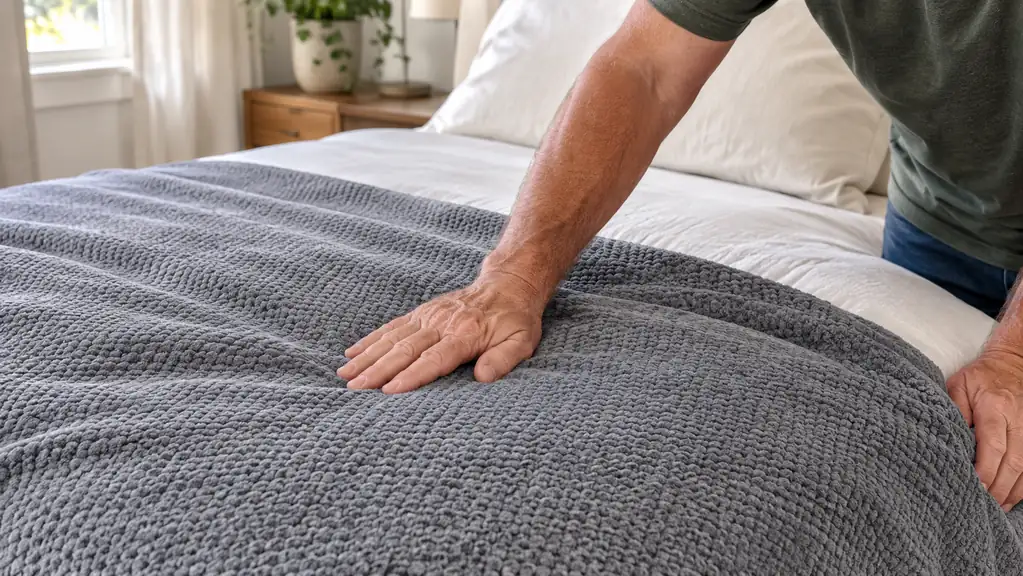
The first night I unfolded it, I was skeptical in the way I am about anything with a name like Arc-Chill. I got in, put my hand flat on the fabric for a minute, and it was cool the way the underside of a pillow is cool. Not cold. Not the shock of an ice pack. Just noticeably cooler than the sheet next to it. I fell asleep before I had time to be disappointed, which for me in May was unusual enough that I noticed.
One night in the second week of July I actually measured it, because I wanted a number instead of a feeling. The bedroom was at 75 when I got in, per the thermometer on Dale's nightstand. I lay down at 10:40 and the fabric under my back was cool to the touch, clearly cooler than the sheet at my feet. At 11:20 it was neutral, the same as everything else in the bed. I still slept about three hours straight, which for that month counted as a good night. The blanket had not gotten warm. It had simply caught up to the room, which is what the fabric description says it will do.
What the Fabric Does, in Plain Terms
The Elegear blanket is made with what the company calls Arc-Chill 3.0 cooling fabric, a 100 percent cooling nylon with jade nano-particles worked into the fibers. The number that gets quoted is Q-Max, which measures how much heat a fabric pulls off your skin the instant you touch it. Elegear lists theirs above 0.5. You do not need to know the units. You need to know that this is a contact measurement, not a room-cooling one.
That distinction is where most of the disappointment with cooling blankets comes from. A blanket like this does not chill the air underneath it. It moves heat away from your skin faster than cotton does, and once the fabric has absorbed what it can, it reaches equilibrium with the room like anything else. So the sensation is front-loaded. Cool for the first stretch, neutral after that, never actively warm unless you trap heat under it.
The construction is two-sided on purpose. The listing describes it as cool on one face and dry on the other, with moisture moving one way, away from you. In practice that means one side is the side you want against your skin and the other is the side you want facing up. I had it backwards once in June and spent a night vaguely irritated without being able to say why. Now I check the tag before I make the bed.
The other half of the design is the part I did not expect to care about. The fabric is built so moisture moves off your skin toward the other side instead of sitting in a film. I noticed it most on the nights I woke up already damp. Cotton in that state feels cold and clammy against my back. This feels dry within a couple of minutes, and the difference between clammy and dry at 3 a.m. is most of the battle.
Two Weeks In vs. Four Months In
The first two weeks I was probably not a fair judge, because I was paying attention. Every night I got in and thought, yes, that is cold. Novelty does a lot of work. I also made the mistake of assuming the coolness would hold all night, and on the first genuinely hot night I woke at 2 a.m. annoyed that the blanket felt like a blanket.
There was one night in early June that I remember because it was the first honest test. Storms knocked the power out around eight, the house was up to 79 by bedtime, and I got in expecting nothing at all. It felt cool for maybe fifteen minutes, which was fifteen minutes of not lying there gritting my teeth, and then it went neutral. I slept anyway. Two summers ago that same kind of night would have had me on the couch by one in the morning with the television on.
Four months in, my expectations have settled somewhere more useful. The coolness is real and it is short. What has held up is the dryness and the weight. At 1,335 grams it is thin and light, nothing at all like the comforter Dale sleeps under, and that thinness matters more to me now than the initial cold shock. Something heavy on my legs is half of what wakes me up in the first place.
The fabric itself has not changed that I can tell. No pilling along the edges, no thin spots where I bunch it up every night, no fading after roughly a dozen washes. The striped pattern still looks like it did in May. I have owned blankets that looked tired by August. This one does not.
Sharing a Bed With Someone Who Runs Cold
This is the part I did not think about before I bought it and would think about now. Dale runs cold. He would sleep under a duvet in July. For the first week I tried to make one arrangement work for both of us, which is a fool's errand, and then I gave up and we each built our own half. He has his comforter. I have the cooling blanket plus a quilt on cool nights. Nobody has to negotiate at 3 a.m.
The size helps. At 79 by 86 inches it covers my half of a queen bed completely and then some, so there is no cold strip down the middle where two sets of bedding fail to meet. If you are on a full bed or sleeping alone, you will have more blanket than you need, which is not a problem unless you hate extra fabric around your feet.
One thing to know: it is slippery. The surface slides against a cotton sheet. I solved it by tucking the bottom edge under the mattress, which takes five seconds and ends the argument. If you sleep on satin or bamboo sheets, expect more sliding than that.
There is also a small peacekeeping benefit I did not anticipate. When I used to throw the comforter off in the night, Dale would wake up, and then we would both be awake. Now I have my own layer to shed and his stays where it is. He sleeps through it. So do I, more often than not.
Washing It, and What I Got Wrong
The care instructions on the Elegear listing are more particular than a cotton blanket's, and they are worth reading once. Machine washable, wash water at 86 degrees Fahrenheit. Air dry is recommended. If you tumble dry, use the lowest heat, which the listing caps at 120 degrees. I air dried mine on the porch rail for the first two months because I did not want to be the person who ruins a blanket in the dryer.
Then September got busy and I put it through on low heat twice. It came out fine, no shrinkage I could measure, no change in how it feels. That is one data point, not a recommendation. Heat is what degrades this kind of fabric, so the lower and the less often, the better. I have gone back to air drying when I have the time.
The first wash I did wrong in a small way. I ran it on a normal cycle out of laziness instead of a gentle one, and pulled it out convinced I had wrecked the texture. I had not. It felt slightly crisper than before for about one night, then went back to normal once it was on the bed. Since then I use the gentle cycle and cold water, which sits well under the 86 degree ceiling the listing gives.
Two habits of mine that are not in the instructions. I skip fabric softener and dryer sheets on it, because coating a fabric that is supposed to move moisture seems like it would defeat the point, and I wash it on its own so a duvet cover zipper does not snag it. The OEKO-TEX Standard 100 certification is on the listing, which mattered to me mostly because this thing sits against bare skin for eight hours a night.
What I Liked
- Feels distinctly cool on contact, not merely thin
- Dry rather than clammy on the nights I wake up damp
- Light at 1,335 grams, so nothing heavy resting on my legs
- 79 by 86 inches covers my half of a queen bed with fabric to spare
- Machine washable with no pilling after about a dozen washes
- OEKO-TEX Standard 100 certified, which matters for skin contact
Where It Falls Short
- Cooling fades after a few hours, it does not last until morning
- Slippery against cotton sheets and needs tucking in
- Air dry is recommended, so laundry takes longer than you expect
- In a room above the mid-70s it feels neutral rather than cool
- It is a comfort tool, not a treatment for night sweats
It does not stop a hot flash. It cuts the ten worst minutes down to about three, and those ten minutes were the part I could never get through on my own.
Who This Is For
If you wake up hot two or three times a night and the thing that drags it out is lying there waiting for your body to settle, this is worth trying. It shortens the wait. It has been the most useful change to my side of the bed in three years, ahead of a fan and well ahead of the various sheets I tried before it.
It is also a reasonable fit if you sleep next to someone whose bedding runs warmer or heavier than yours. Two people, two setups, no negotiating at 3 a.m. And if you are the sort who sleeps hot but cannot stand the feel of a heavy blanket at all, the weight alone might be the argument.
I would also say this: give it two weeks before you decide. The first few nights I was judging it against an impossible standard, and the honest read only showed up after I stopped noticing it was there. The measure I use now is simpler. How many times did I get up? In May it was three or four. Most weeks now it is one, and sometimes none.
Who Should Skip It
If you are looking for something that will keep you cold from ten at night until six in the morning, skip it. No blanket does that. The cooling is real but front-loaded, and if a short burst of cold followed by neutral is going to annoy you, you will be annoyed by this one too.
Skip it too if your bedroom runs hot and you are not willing to fix that first. A cooling blanket in a 78 degree room is a thin blanket. The thermostat, a fan, and a window that opens do more work than any fabric will. And if night sweats are new, heavy, or arriving with other symptoms, that is a conversation with your doctor about hormones and medication, not a purchase. Mine knows what I am doing and I follow her advice on everything medical. This blanket is comfort. It is not treatment.
If your night goes the way mine did, start with the blanket on your half
79 by 86 inches, machine washable, cool on the way in and dry on the 3 a.m. wake-up. It will not fix a hot flash. It will shorten the wait.
Amazon Check Today's Price on Amazon →